Saturday, March 26, 2022

Feminist Organizing Across the Generations. Part I: Building the feminist movement, Chapter 2, Victories in education and employment opportunities

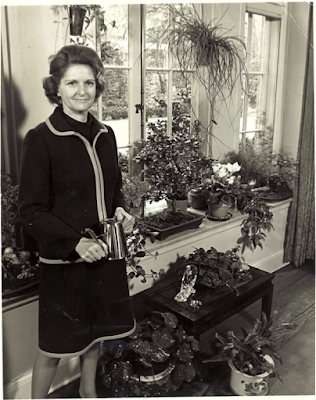
Penelope Brace, the first woman detective in the Philadelphia police department.

Title IX of the 1972 Education Amendments Act, for which NOW had aggressively lobbied, had placed a powerful tool in feminist hands. Any educational program receiving federal financial assistance could not discriminate with regard to sex; athletics programs quickly became a major focus of feminist efforts to provide equal educational opportunities for girls. Also, Billy Jean King’s trouncing Bobby Riggs certainly provided inspiration and much-needed publicity for women’s sports. NOW was not fighting for “separate but equal” athletics programs but rather for integrated gym and extracurricular sports activity. In a lengthy article in the Pennsylvania NOW Times Beverly Jones explained the rationale for NOW’s position on integrated sports activity:
One, we are interested in equality of opportunity not just to participate but to excel. And history has shown that when those who are under-privileged and discriminated against are shunted off into separate programs, the opportunity for any of their number to excel in the total community is ephemeral indeed.16

Jones contended that there was no evidence that in a fair, integrated athletic program girls and women would be unable to hold their own. In 1974 most people (including some feminists) were not ready for Jones’ vision. From the perspective of the 21st century, with women soldiers courageously serving in Iraq and Afghanistan, Jones’ ideas seem far less radical.

On March 19, 1975, the Pennsylvania Commonwealth Court ruled 5 to 1 that the Pennsylvania Interscholastic Athletic Association (PIAA) rule prohibiting girls from competing against boys in interscholastic athletics was unconstitutional. The majority decision, written by Judge Genevieve Blatt, rejected PIAA’s contention that, as a whole, girls are weaker and more injury-prone. NOW members were well aware that progress was not just a matter of changing laws. NOW itself was founded because of frustration with the Equal Employment Opportunity Commission’s unwillingness to enforce existing laws against sex discrimination. In her analysis of PIAA’s decision to comply with the Commonwealth Court ruling, Philadelphia NOW member Carol Kranick concluded with a warning that the struggle had just begun:
For those who feel that once you win the legal battle, the war is over, they need only to look at the abortion scene. We won the Supreme Court decision. But we are still in the battle of improving the climate so that decisions can be, in fact, the law of the land.

Kranick noted that in sports, as in the battle for abortion rights, feminists have eliminated the legal barriers: “The legal victory placed us in the position of being able to fight the next barrier and we are much closer, much sooner than any of us dreamed to the goal of total equality—at least in sport."21

NOW used a variety of tactics, lobbying, rallying, demonstrating,and when all else failed, resorting to legal action. Philadelphia NOW found it necessary to take legal action to win one of its major victories over the Philadelphia School Disrict—-the protracted struggle to integrate Central High School, the once male-only school for the academically talented. In 1974, Susan Lynn Vorchheimer, an honors student and winner of multiple awards, decided she wanted to attend Central High School because “it had a better reputation than Philadelphia High School for Girls, the other academic high school in the City.”23 Although her academic qualifications were undisputed, Vorchheimer’s application was rejected. Her parents sued the School District and the court ruled in Vorcheimer’s favor. The Philadelphia Board of Education successfully appealed the decision, and Vorchheimer returned to her neighborhood school. The appellate court claimed that gender had never been a suspect classification, requiring the level of scrutiny required for claims of racial discrimination. The suit eventually made its way to the US Supreme Court which in 1977 issued a four-to-four decision allowing the appellate court ruling to stand.

The situation was not resolved until 1983, when Common Pleas Court Judge William M. Marutani ordered the Philadelphia School District to admit six girls to Central High School. Marutani’s ruling stated that Central’s facilities were “materially superior” to those at Girls High, and that the “educational opportunities are materially unequal”; therefore, the district’s policy violated the 14th amendment to the Constitution and the Equal Rights Amendment to the Pennsylvania Constitution.27 The desegregation of Central High received national attention; the New York Times reported:
The girls who walked up the steps at about 8 A.M. today to break the tradition appeared self-contained and pleased. “I’m excited, but nervous,” said Karen Seif. Elizabeth Newberg, the young woman who a year ago persuaded two friends to join her in instituting the suit, proclaimed. “I’m here. I feel fine.” Miss Newberg said she planned to start a women’s organization at Central but would not exclude males.28

Despite continuing opposition from Central alumni, the School District bowed to the pressure of public opinion and did not pursue appeals. By the time of the final victory in 1983, NOW was one of many organizations supporting the end of gender segregation. The tide of public opinion had turned, with the local establishment generally in support of integrating Central High. A Philadelphia Inquirer editorial stated: “Thus it is understandable, but no longer defensible, that the two schools have continued to maintain single-sex enrollments despite changing laws and customs.”29 Very quickly the enrollment of girls at Central, once unthinkable to some alumni and local power brokers, became the new normal. Sometimes NOW’s victories were swift and decisive (e.g., the desegregation of Help Wanted ads), at other times long and protracted (e.g., the nine-year battle to integrate Central High), but the trajectory of NOW in the 1970s was victory after victory.

NOW has sometimes been characterized as a middle-class women’s organization primarily concerned with expanding opportunities for relatively privileged women and girls. However, a major priority for NOW in the middle 1970s was the struggle to desegregate what were for women “non-traditional jobs”—well-paid blue-collar jobs traditionally held by men. Given the dramatic changes in our society, it is easy to forget what a radical notion it was to demand that police and fire departments and construction sites be open to women. According to historian Nancy MacLean, when civil rights groups fought to open jobs to African-American women, they targeted white women’s jobs rather than the relatively well-paid jobs held by white men. Female union activists focused on improving conditions and pay in the jobs women already held. MacLean quotes one labor activist: “We never questioned it when they posted female and male jobs…we didn’t realize it was discrimination … .”30 It took the conceptual breakthrough of the feminist movement to build labor union support for opening up traditionally male jobs to women.

National NOW’s ground-breaking campaign against AT&T in the case of Lorena Weeks vs. Southern Bell Telephone established the principle that an employer could not automatically assume physically demanding jobs could be performed only by men, but must consider the qualifications of individual applicants without regard to sex. The beneficiaries of this decision were largely working-class women. In 1966, Lorena Weeks, who had worked as a telephone operator for Southern Bell, applied for a better paying job as a “switchman” and was told this job could be performed only by a man. Weeks sued in Federal Court, but the US District Court ruled against her because the job involved “strenuous activity” such as lifting 31-pound equipment, a violation of a Georgia regulation prohibiting women employees from lifting weights in excess of 30 pounds. When Weeks’ court-appointed lawyer refused to file an appeal, she contacted NOW, whose attorneys took the case. NOW attorney Sylvia Roberts, “a little smaller than the average woman casually lifted all of the equipment required for the job,” thus demolishing the “strenuous activity” argument.31

On March 4, 1969 the Fifth United States Circuit Court ruled that sex was not a bona fide qualification for the job; thus, Southern Bell was in violation of Title VII of the 1964 Civil Rights Act, which barred sex discrimination in employment. From the decision as quoted in NOW Acts: “Men have always had the right to determine whether the incremental increase in remuneration for strenuous, dangerous, obnoxious or unromantic tasks is worth the candle. The promise of Title VII is that women are now on equal footing.” The Court told Southern Bell it must consider Weeks for the job, and sent the case back to the lower court for “determination and appropriate relief.” NOW Acts reported: “Appropriate relief” came March 4, 1971, when Weeks was appointed to a switchman’s job, but then subjected to harassment on the job: “A Supervisor in her area told workers to treat her “just like any nigger” and co-workers took to calling her “switch bitch.” Her union, Communication Workers of America, condemned the use of “nigger” but dismissed “switch bitch” as “humorous office camaraderie.” In response to this harassment, on March 29, 1971, NOW members staged a nation-wide demonstration in 15 cities; among the picket signs was “Switch Bitch is Beautiful.” As a consequence of the media attention, Southern Bell took measures to protect Weeks from harassment.32

The major effort in Philadelphia NOW’s campaign to open non-traditional jobs to women was its strong, sustained support for NOW member Penelope Brace’s battle against discrimination in the Philadelphia Police Department. Brace had been a police officer in the Juvenile Aid Division for nine years when she decided she wanted to become a detective—a more challenging, better-paid position. She was told she wasn’t qualified to take the exam because she was a woman. She filed suit against the department; three days later she was fired. According to NOW member Lillian Ciarrochi, “The reason given was that she had not logged her coffee breaks!”33 The City Civil Service Commission ordered Brace reinstated three months later but, as Ciarrochi reported: “The harassment was just beginning. She was ordered to take psychiatric examinations, assigned to the district farthest from her home and received anonymous threats that her house would be fire-bombed.”34

Ciarrochi described how NOW supported Brace and encouraged her to file a lawsuit. The United States Justice Department also filed a lawsuit against the Philadelphia Police Department and withheld $4 million of federal funds because of its treatment of Brace. The Philadelphia Police Department appeared not to realize that the world had changed, and in federal court it “admitted to discrimination because, they said, women are constitutionally, emotionally, and psychologically unable to do the job.”36

On March 7, 1976, the City of Philadelphia and the US Justice Department entered into agreement in the Penelope Brace case. Under the terms of that settlement, the Police Department would hire a hundred women for street patrol duty and conduct a two-year study of the women’s performance. When a hundred new female police officers entered the Police Academy in June 1976, the Police Department did everything imaginable to discourage the new recruits. According to a Philadelphia Daily News article written on the 20th anniversary of 1976 agreement:
The women were to chop their hair off into what was called a “butch” cut. They were given men’s uniforms and shoes, and were told to wear T-shirts under their dress shirts so no trace of a bra showed. Finally, they were assigned to the six police districts with the highest crime rates in the city. And when they arrived at those districts, they were sent out on patrol alone, without the benefit of a breaking-in period with an experienced officer that all of the male cops enjoyed.37

Ironically, despite placing women officers in dangerous conditions, Police Commissioner O’Neill claimed that his reason for opposing women on the force was concern for their safety. In a 1996 interview with the then retired O’Neill, he still claimed to be motivated by concern for the women officers’ well-being: “I’m still very much concerned about their personal safety. Every time I see them roaming around alone, I express concern.”38

In 1978, under an order from US District Judge Charles Weiner, Brace became the city’s first woman detective. However, real change would come only with a change in top command. As late as 1978 in response to a federal attorney’s question why women were not assigned to patrol duty, O’Neill replied:
Because God in his infinite wisdom made them different … . In general they are weaker than males. I believe they would be inclined to let their emotions overtake their good judgment. I don’t mean to embarrass the ladies but there are periods in their life when they are psychologically unbalanced because of physical problems occurring within them.39

It was not until O’Neill retired in 1980 and Morton Solomon took over as police commissioner that the six-year lawsuit between the federal government and the Philadelphia Police Department was finally settled. Women were given the opportunity to work throughout the department, and Commissioner Solomon ended the petty cruelty of forcing women to wear uniforms designed for male officers, ordering that uniforms designed specifically for the female body be made available to women officers. The agreement also called for the city to pay $700,000 in back pay to be divided among the victims of sexual discrimination and committed the department to a 30 percent hiring goal for female police officers. Given what Brace and other female police officers endured, the financial settlement was woefully inadequate, but Brace and other victims had reached the end of the legal road. Brace said she would do it all again: “Looking back … if I had to do it again, I would file the suit, but I would have done it sooner.”40

As a result of her lawsuit, An important principle had been established, but the Police Department was very far from gender parity. Slow but steady progress occurred throughout the 1980s and early 1990s. In a 1996 interview with the Philadelphia Daily News, Brace urged other women police officers to continue the struggle: “I’m sure there are many qualified women … . I would urge them to file suit. It takes a revolution. You can’t change the Joe O’Neill’s of this world so you have to take them to court. It’s an old boys’ network that has to be stopped.”42

The ugly treatment of women aspiring to non-traditional jobs was not confined to the Philadelphia Police Department, but occurred in police and fire departments around the country. In her account of the resistance encountered by New York City fire fighter Brenda Berkman, Nancy MacLean stated: “What Berkman and her colleagues encountered when they crossed those once-undisputed gender boundaries was not simply reasoned, judicious skepticism from people who doubted the capacity of the new-comers to do the job. Repeatedly what they met was elemental anger that they would even dare to try.”43

The progress made in the Police Department would not have been possible without courageous women like Penelope Brace and without a feminist support network, which encouraged Brace to file her suit and supported her struggle. Both Brace and her allies in NOW saw her case as part of a much larger battle against employment discrimination—one played out on national, state, and local levels. With its federated structure, NOW was well positioned to mobilize politically to pressure politicians and judges, whether appointed by politicians or elected by voters.

By 1975, the feminist movement in general and NOW in particular had much to be proud of: the Supreme Court decisions guaranteeing the right to abortion and ending gender segregation in classified ads; the landmark settlement with AT&T; and Title IX of the 1972 Education Amendments Act, which expanded athletic opportunities for women, to cite a few of the most dramatic victories. Major social institutions were undergoing rapid changes, which only a few years earlier would have struck many citizens as unthinkable. NOW activists themselves were dazzled by the speed and extent of the changes the feminist movement had wrought. Very few women’s lives were untouched.

NOW members were poised for still greater victories and confident that they would achieve passage of the ERA by the end of the decade. But the strains of building a movement on volunteer energy alone were increasingly apparent.There were clearly too few people doing too much work. In the early 1970s, the president may have been suffering from exhaustion, but there was always a new energized leader ready to take her place. By the mid-1970s, at a time when Philadelphia could justly savor its victories, burnout and exhaustion were spreading throughout the organization.

Not only were there many more phone calls for the volunteer staff to respond to, new members brought new ideas about the direction and focus of NOW. Throughout 1975, the national organization was roiled by major disagreements about the direction of NOW, culminating in the bitterly fought election at the national NOW convention in Philadelphia in October 1975. The following year, deep divisions were to emerge in the Philadelphia chapter as well. In many ways the conflicts were the inevitable by-product of NOW’s success—its dramatic growth and increasing ideological diversity.

Friday, March 25, 2022

Feminist Organizing Across the Generations. Part I: Building the feminist movement, Chapter 2, Building a Structure for the Long Haul

Eleanor Smeal, past president of National NOW and architect of NOW's federated structure

Although social movements include a range of organizations, they are generally powered by a handful of strong organizations, with NOW considered the engine behind the feminist movement of the 1960s and 1970s. At the same time as NOW was fighting for gender justice in the media, educational institutions, and employment, it was also focused on building an organizational structure for the long haul. Many of the victories of the early and mid-1970s would not have been possible without this attention to structure, which spurred membership growth and laid the groundwork for future victories. It is surely a major reason NOW is one of the few organizations to emerge from second-wave feminism still standing.

The women who built NOW in the early years had considerable experience in building and running organizations. Many of the women on the national level were likely to have worked in national progressive organizations, including labor unions and professional associations. Local leaders were likely to have been involved in neighborhood civic organizations and local affiliates of professional organizations. Thus, NOW’s early leaders were comfortable with hierarchical structure, elaborate bylaws and officers elected by well-defined procedures, in sharp contrast to those who identified with the Women’s Liberation Movement, which was amorphous, non-hierarchical, and generally without an elected leadership. Many histories of second-wave feminism have viewed NOW’s emphasis on structure as evidence of its conservative bent in contrast to the revolutionary potential of the supposedly more radical Women’s Liberation Movement. Many NOW members, on the other hand, saw themselves as the real radicals, using mainstream tactics to achieve radical goals.

Nationally, NOW’s focus on structure reflected the leadership of brilliant strategic thinkers such as Eleanor Smeal, who realized the importance of developing organizations which could accommodate NOW’s dramatic growth. NOW’s development of hierarchical structures may have made the organization less attractive to younger feminists in the late 1960s and 1970s, but it enabled the organization to operate effectively in the political arena and navigate the increasingly bitter divisions and disagreements within the feminist movement. The ease with which NOW members could set up local affiliates provided a vehicle for managing internal conflicts without rupturing the organization—especially important for a volunteer-dependent organization, particularly vulnerable to disintegration due to internal tensions.

Creating a national organization with state and local affiliates was an enormous challenge, and the basic structure evolved over roughly a ten-year period. Betty Friedan, NOW’s charismatic founder, was not all that interested or skilled in grassroots organizing. However, many NOW activists were very much concerned with building local affiliates. The time and careful thought they devoted to creating this network of grassroots organizations provide at least part of the explanation as to why NOW survived while so many other organizations had their brief moment in the sun and then disappeared.

NOW was creating a structure to accommodate growth and adopted a “Statement of Purpose” Carabillo considered “almost elastic enough to encompass the enlarged agenda of women’s issues that emerged in the next ten years.” The mission statement provided room for NOW to expand its agenda and recognized that “women’s problems are linked to many broader questions of social justice.”3

Considerable thought was given to managing NOW’s growth and integrating the various levels of NOW (local, state, regional, and national) to create an organization with effective channels of communication between the national organization and its affiliates.

The rationale for creating a federated organization was developed in 1973 by Pennsylvania NOW member Beverly Jones who distinguished between issues that must be addressed at national level and those more suited to state level, arguing that changes in society’s basic institutions can be made only at the national level: “If we are ever to get decent full-day nursery schools in this country for all parents who need or want them, the federal government must of necessity supply the funds and the legislation.”5 Jones argued that state-level organization is essential, as much of what is agreed to at the national level must be implemented by the states; she cited the ERA (which must be ratified by the states) as an example of the critical importance of state-level organization. Jones also understood that emotional sustenance and personal bonds usually could be created only on the local level.

According to Jones, feminist organizations acting independently of each other cannot advance the feminist cause: “Non-coordinated activity can and will squander women’s time, money, and energy for little purpose.” She believed that women needed one democratic, feminist organization, and contended that only NOW was up to the job. She noted that NOW was the first organization to form in the second-wave feminist movement and that “it predated even the first of the woman’s liberation groups, which rose in a different constituency and developed a sort of loose parallel formation starting in the late 1960s.” Jones linked the woman’s liberation movement’s distrust of NOW’s formal structure with broader generational tensions. She believed that a younger generation of women influenced by the New Left’s distrust of centralization was abandoning the opportunity to change institutions: “[They] want to talk about changing their life style rather than changing institutionalized sexism, [and] in the name of democracy repudiate structure and rule in little cliques.” Jones’ argument had a somewhat defensive tone, no doubt reflecting the criticisms of NOW coming from younger members of the feminist movement.

Like Jo Freeman, who also analyzed the dangers of “structurelessness” in social movements,6 Jones argued that if leadership emerges without some electoral process, it cannot be easily dislodged; there are no orderly processes for resolving conflicts. The document reads as though Jones was struggling to suppress her own intense irritation with feminists who reject formal structures. The anger breaks through loud and clear in the final pages:
That organized oppression can be fought by unorganized opposition is almost too silly a statement to comment on … unaffiliated women often feel they are making individual progress of a feminist sort struggling alone in the home and on the job. And they think of this over-all struggle of the unaffiliated as unorganized opposition. However, if there were no organized groups bringing lawsuits, lobbying, marching, conducting boycotts, and otherwise making headway and headlines, unaffiliated women would have precious little leverage to apply in individual struggle.

There’s no evidence as to how widely Jones’ analysis was read or may have influenced the younger women drawn to the unstructured organizations Jones attacks. No doubt, some would have been alienated by the somewhat hectoring tone rather than impressed by the strength of Jones’ arguments.

It is undeniable that NOW’s focus on structure was one of its great strengths and was generally acknowledged as one of its defining characteristics. Like many advocacy organizations, NOW at times conveyed the impression that it was the sole force behind legislative victories and changes in government regulations. In the area of employment discrimination, NOW can certainly claim that it played the leading role. NOW was also a major (but certainly not the only) force in combating sexism in educational institutions. NOW acknowledged it shared the credit, noting it had “substantially aided the passage of amendments to the Higher Education Act of 1972 which include … prohibitions against sex discrimination in any educational program or activity receiving federal funding.”

Not all the accomplishments NOW cited in the 1972 press release were tied to specific pieces of legislation or changes in government regulations. Some were in the more nebulous category of changing hearts and minds, such as, “raising the consciousness of the country to the stereotyped images of women pervasive in the media and in advertising.” NOW was clearly not alone in this effort; however, NOW focused not only on changing consciousness but also on changing the rules of the game.

NOW would not have been as effective had it not been for the many local chapters across the country working to advance national policies. Among the national NOW objectives most vigorously pursued by Philadelphia NOW was the desegregation of classified ads in local newspapers. When the United States Supreme Court ruled sex-segregated want ads unconstitutional on June 21, 1973, Philadelphia NOW pressured major daily newspapers to comply with the court decision immediately. Philadelphia NOW’s public relations officer Judy Foley wrote letters to the local newspapers urging speedy compliance. The responses to her letters indicated the newspapers were less than enthusiastic about the change.

With the same message coming from both national NOW and local chapters, NOW’s message was amplified and the pressure intensified. the major daily newspapers capitulated and announced they would end their sex-segregated reporting as of August 29, 1973. Philadelphia NOW cautioned: "Let none of us think the battle stops there... Some persistent monitoring can help see to it that this does not become a means of subtly evading the spirit of the ruling."

Given that the Supreme Court ruling was a 5–4 decision with liberal icon William O. Douglas among the four dissenters, NOW members had reason to fear attempts to undermine the ruling. Douglas framed his dissenting opinion in terms of freedom of speech, asserting: “I believe that commercial materials also have First Amendment protection … there can be no valid law censoring the Press.” It is inconceivable that the Supreme Court in 1973 would let stand separate classified ads for whites and Blacks on first amendment grounds. The dissenting justices’ justification of gender-segregated ads as protected by the first amendment speaks volumes about the depth and pervasiveness of sexism in the early 1970s.

Although NOW was generally acknowledged as the major feminist organization fighting sexism in the media and discrimination in employment, in the struggle to eliminate sexism in education other organizations played key roles (for example, the American Association of University Women, the National Education Association, and numerous women’s caucuses in teachers unions and professional organizations). It appeared that just about every woman (and some men) involved in education awoke at the same time to the pervasive sexism in schools. In the mid-1970s national NOW made combating sexism in schools a top priority, focusing on advocacy for Women’s Studies programs in high schools and colleges and for expansion of athletic opportunities for girls. NOW chapters across the country took up the crusade; the Philadelphia chapter was especially active, no doubt because of the many educators among its activist core. NOW’s federated structure was well suited to wage the battle to eliminate sexism in education as educational policy was made on national, state, and local levels, providing NOW activists with the opportunity to coordinate strategy on all three levels of government.

Although NOW was generally acknowledged as the major feminist organization fighting sexism in the media and discrimination in employment, in the struggle to eliminate sexism in education other organizations played key roles (for example, the American Association of University Women, the National Education Association, and numerous women’s caucuses in teachers unions and professional organizations). It appeared that just about every woman (and some men) involved in education awoke at the same time to the pervasive sexism in schools. In the mid-1970s national NOW made combating sexism in schools a top priority, focusing on advocacy for Women’s Studies programs in high schools and colleges and for expansion of athletic opportunities for girls. NOW chapters across the country took up the crusade; the Philadelphia chapter was especially active, no doubt because of the many educators among its activist core. NOW’s federated structure was well suited to wage the battle to eliminate sexism in education as educational policy was made on national, state, and local levels, providing NOW activists with the opportunity to coordinate strategy on all three levels of government.

Tuesday, March 22, 2022

Feminist Organizing Across the Generations. Part I, Building the feminist movement: Chapter 1 Philadelphia NOW: The first NOW chapter to elect an open lesbian as president

Jan Welsh distributing 1973 Barefoot and Pregnant Awards

Because of the class background and elite credentials of the first leaders of Philadelphia NOW, the organization was viewed as an establishment group in contrast to the apparently more radical Women’s Liberation Movement which was garnering media attention in the late 1960s and early 1970s. However, the Women’s Liberation Movement was not more radical than NOW with regard to lesbian rights. Although there was certainly a pro-lesbian strand in the Women’s Liberation movement, there was also a homophobic strand. As Alice Echols in her influential study of radical feminism noted: “many radical feminists … were often skittish if not hostile toward lesbianism.” Echols cited the radical group Redstockings’ view of lesbianism as a movement “to replace feminism or eliminate it, or else … dilute it.

Although in the early 1970s some NOW chapters saw limiting visible lesbian participation as essential to building their chapter, Philadelphia NOW viewed outreach to the lesbian community as an opportunity for organization building, becoming the first NOW chapter to elect an open lesbian as chapter president. The election of Jan Welch, a 35-year-old horticulture therapist, on June 26, 1973 attracted considerable media attention. Nancy Greenberg’s feature-length article in the Sunday Bulletin Magazine described Welch’s response to her election:
My being elected in June has done something for me. You can count the lesbians in this NOW chapter on one hand; yet, I didn’t get one negative letter or phone call. Two weeks before the election I publicly announced my homosexuality and everybody took it as strength of character. It gave me an incredible high—no one was talking about my sexuality, only my candor. I was noble all of a sudden.

As with other lesbians in her age cohort, for Welch coming out was a painful experience. Her mother refused to accept that her daughter was a lesbian and wanted her to have female hormone treatments. Her father was more willing to accept the reality of her sexual orientation. According to Welch, “He believed I was a lesbian but thought life would just be easier for me if I could change.” To please her parents, she went to a psychotherapist who told her to “just go out and date a lot.” She went out with “straight guys and then with gay guys and then gay women.” Her father came to terms with her sexuality and she reported that when she told him she was coming out, “he said he was joyous.”

Jan Welch eventually found acceptance both within her family and, somewhat to her surprise, in Philadelphia NOW. Thanks to Betty Friedan’s much publicized reference to lesbians as the “Lavender Menace,” anti-lesbian feelings have been associated with NOW. These attitudes, however, were largely confined to Friedan. NOW’s second president Aileen Hernandez, who succeeded Friedan in 1970, and its third president, Wilma Scott Heide, who took office in 1971, were both strong supporters of lesbian rights. At the 1971 national NOW conference a resolution was passed acknowledging that it was time to speak out directly and forthrightly on lesbian rights. The 1971 resolution stated: “No other woman suffers more abuse and discrimination for the right to be her own person, than does the lesbian … the lesbian is doubly oppressed, both as a woman and as a homosexual.” A second resolution passed at the 1971 conference specifically addresses the rights of lesbian mothers.

Although Betty Friedan’s position on lesbians has been widely reported, the repudiation of Friedan by grassroots NOW members on local and regional levels has received less attention. Jean Buckalew reported in the Philadelphia NOW Newsletter that Friedan “received a rebuke from a large contingent of lesbians” at the 1972 NOW Eastern Regional Conference. Buckalew expressed the frustration shared by many NOW members: “How on earth Ms. Friedan can exclude one segment of the female population, i.e., lesbians, from the Women’s Movement is beyond a reasonable woman’s comprehension. Does she not know that lesbians are women? Really, Betty!” In 1973, the board of Philadelphia NOW passed a resolution of censure against Friedan. From the text of the resolution:
Whereas: Betty Friedan, a NOW member nationally recognized by the media, implied in a March 4, 1973, article in the New York Times that lesbians were “man-haters” and sought to divide the women’s movement … Be it Resolved: That the Philadelphia Chapter of the National Organization for Women calls on the National Board of Directors of NOW to censure Ms. Friedan for her statements, and to state, unequivocally that these statements do not represent the policy of the National Organization for Women.

Although NOW’s image among feminists was tarnished by its association with Friedan’s statements, the reality was that most grassroots NOW members rejected homophobia, and sought to distance themselves from Friedan.

Jan Welch felt quite comfortable running for chapter president in Philadelphia, but she was concerned about Friedan, who, although no longer president of national NOW, was still very much associated with NOW by the press and the general public. According to NOW activist Lillian Ciarrochi, Friedan tried to pressure Welch to withdraw her candidacy. Friedan called Welch and asked her to come to New York to meet with some prominent feminists. Ciarrochi described them as “the Park Avenue crowd, famous Broadway female actors, famous women writers … all very well-known and very wealthy.” Clearly, the aim was to intimidate Welch. As Ciarrochi recalled Jan’s description of the encounter:
Jan went in to this big law firm and into this conference room with all of these women in silk dresses, and Betty was screaming and yelling at her saying she wanted her to withdraw from running for president of Philadelphia NOW because she thought it would hurt the movement and that people would be turned off. Jan could be whatever lifestyle she wanted but it shouldn’t be advertised.

According to Ciarrochi, “Jan stood her ground and she said that she didn’t see why she had to lead a secret life. She didn’t want it to be an issue but she wanted it known because that’s who she was.” Friedan’s hardball tactics failed and Ciarrochi reported that by the time the meeting was over many of the women were “going over to [Jan] and hugging her, saying stick to your guns, you’re right.”
Ciarrochi thought that Friedan was not personally homophobic but that she was motivated by fear that association with lesbianism would hurt the movement and deeply concerned that NOW be taken seriously as “a select committee of professional women.”77 It is difficult to disentangle anti-lesbian feeling from Friedan’s distaste for what she allegedly called “scruffy feminists.” From Roxanne Dunbar’s account of her joint appearance with Friedan on a New York television program:
She began a verbal assault on me in the dressing room when I refused to have make-up applied, and she did not stop until the show was over. I was dressed in my very best army surplus white cotton sailor trousers and a white man’s shirt. She said that I and scruffy feminists like me were giving the movement a bad name.

Although concern about a respectable image may explain Friedan’s behavior more than homophobia, there is evidence that Friedan in the 1960s and early 1970s had some visceral antipathy towards homosexuals. Her biographer, Judith Hennessee, described her personal attitudes as “an uneasy jumble of contradictions,” and quoted passages in The Feminine Mystique that were clearly homophobic. According to Hennessee, Friedan “saw homosexuality ‘spreading like murky smog over the American scene’ and considered it ominous.”

Despite the tendency of the press to conflate Friedan’s views with NOW’s, by the early 1970s she was increasingly out of step with the organization she founded. However, Friedan’s attitudes clearly evolved and at the 1977 National Women’s Conference in Houston she made a famous speech repudiating her former opposition to lesbian rights. From Lillian Ciarrochi’s recollection of Friedan’s speech: “I sat about three feet away from Betty Friedan when she turned and there was a whole contingent of young gay women up in the balcony, carrying purple balloons. Betty was crying and said she was wrong and begged forgiveness from the women.”

When Jan Welch announced her candidacy for the presidency of Philadelphia NOW, she received strong support from Philadelphia NOW executive board members, and from founding member Ernesta Ballard and outgoing president Jean Ferson. Ferson recalled that Welch made sure everyone on the executive board knew about her sexual orientation:
Jan wanted us to know this about her, and I remember the night she told us all and just wanted to be reassured. ‘Do you still want me to run for president knowing this about me?’ And we all said, ‘Absolutely. We think you’d be a good president. We want you.’ We were strongly behind her and that was that.

Welch wanted to make sure the entire membership was aware of her sexual orientation, and wrote an open letter to the Philadelphia NOW membership setting forth her vision for the organization and affirming her sexuality: “So no one feels misled, before the election, let me state that I am a Lesbian … . I am able now to state publicly my sexual orientation because of the sisterly love and support I have received over the past year from many NOW members.” In the open letter, Welch also sought to reassure members that although she considered lesbianism a priority issue for NOW, she intended to work on additional priority issues, as her past history in NOW would indicate. She cited her service as chair of the Philadelphia Chapter’s Employment Task Force, and as NOW spokesperson in favor of the passage of the ERA. In a real shift in direction for Philadelphia NOW, Welch designated 1973 “NOW’s priority year against poverty.”

Although the overwhelming majority of Philadelphia NOW members supported Jan Welch’s candidacy for president, an opposition candidate, Elizabeth Feldman, emerged. The election attracted a good deal of attention and the Philadelphia Bulletin reported that 125 women were present at the meeting to elect a new president. All 81 dues-paying members were present and all cast ballots. Welch won by a wide margin, as did members of her slate. According to the Bulletin, “Ms. Feldman drew hisses and shouts from the audience when she referred to her opponent’s ‘undistinguished credentials.’” In an interview with a Bulletin reporter, Feldman denied that she was running as a “straight” candidate, and that she simply wanted to make the election democratic by giving voters a choice: “I’ve known Jan was a lesbian for a year. I just thought that each office should have more than one person running for it.”

Veteran Philadelphia NOW members Lillian Ciarrochi and Judy Foley were unconvinced by Feldman’s claim that she was running to make the organization more democratic; they saw Feldman’s candidacy as a Betty Friedan-like rearguard action against the “Lavender Menace.” According to Foley:
[Feldman] just didn’t want a lesbian president, so she ran at the last minute as a write-in candidate … it was very tense but she got one, maybe two votes, hers and somebody’s else’s, so it was all right. But it did get us a lot of publicity and I think probably most of it good.

The Drummer reported that Jan Welch won by a vote of 72 to 10.82 Foley’s recollections might have been slightly off regarding the vote total, but she was surely correct that Welch’s election resulted in favorable publicity for Philadelphia NOW.

Jan Welch was elected as the lesbian feminist movement was growing both in numbers and visibility. Philadelphia NOW benefited from its association with the lesbian rights movement, gaining far more members than may have been lost. There was clearly a symbiotic relationship between the lesbian movement and the feminist movement. The talent and energy of many lesbian feminists was of critical importance in building NOW and the feminist movement in general; NOW’s embrace of lesbian rights contributed to the increasing acceptance of homosexuality and to the growth of the lesbian and gay rights movement. In the early 1970s, several lesbian rights groups worked in coalition with Philadelphia NOW and other feminist groups on efforts such as the August 26, 1972 Women’s Equality Day Celebration. This close cooperation was already established in 1972, a year before Welch ran for the presidency of Philadelphia NOW, and no doubt laid the groundwork for her election. In turn, Welch’s election helped to further strengthen these ties.

Although Jan Welch was strongly supported by a majority of Philadelphia NOW members, she recalled, “Because there were only two opponents to my candidacy on sexual preference grounds, I tended to be naive about the election of a lesbian. I felt the issue of lesbianism was as much an accepted principle of NOW as equal pay for equal work.”83 Three-quarters through her term she realized that although her NOW sisters were not personally homophobic, they were sometimes hesitant to speak out against anti-lesbian biases:
Even though there has been continued break-down of the myths and stereotypes about lesbianism in the past year, much more should be done by “straights” to relieve the fear of non-NOW members that NOW women are “just a bunch of dykes.” If NOW members would point out vocally and firmly that there is the same percentage of homosexuals in NOW as in a local business or neighborhood church instead of quickly denying or ignoring the issue completely, the feminist movement would, in general, gain popularity and strength.

Although feminists were generally far ahead of most of their fellow citizens, in the early 1970s many were reluctant to directly confront bias against lesbians and gays.

In addition to outreach to the lesbian community, Jan Welsh also sought to build NOW by reaching out to feminists involved in organized religion. Immediately after her election, Welch organized Sistercelebration, an ecumenical religious service for Women’s Equality Day, August 26, 1973. The religious focus of Sistercelebration was a departure from previous Women’s Equality Day rallies, but not surprising, given that, according to a 1970 survey of Philadelphia NOW members, 59 percent were affiliated with a religious organization. Fifty-nine percent may seem low in comparison with the general population, but it was a relatively high number for those who identified with progressive causes in the early 1970s.

There were frequent references to a feminist perspective on religion in the Philadelphia NOW Newsletters of the early 1970s. Although national NOW’s publications in the early 1970s had fewer such references, in both cases opposition to anti-feminist attitudes in organized religion was a recurrent theme. Among the resolutions passed at the 1971 National NOW Conference was one encouraging women “to divert all or part of their religious contributions to the NOW Ecumenical Task Force on Women and Religion for work being done to improve the role of women in religion.” NOW leaders clearly understood that religion was a powerful institution in American life; to achieve gender equality and combat homophobia, major changes in religious attitudes toward gender roles and sexuality were essential.

For many Philadelphia NOW members, religion was a sensitive subject, as many clearly wanted to maintain their religious affiliation without compromising their feminist values. Philadelphia NOW members apparently did not find it problematic to hold a religious celebration for a secular holiday, the anniversary of the passage of the 19th amendment granting women the right to vote. Unfortunately, there did not appear to be much effort to include non-Christian organizations in the Sistercelebration. Although many Jewish women were involved both in National NOW and in the broad Women’s Liberation movement, and although there were many Jewish women involved in Philadelphia progressive organizations, there were relatively few Jewish women among the NOW leadership in the early 1970s. NOW chapters tended to expand through friendship networks, which may explain the relative absence of Jewish women among the activist core in the 1970s.

Although secular feminists may have been uncomfortable with turning Women’s Equality Day into a religious celebration, outreach to women in religious organizations certainly made sense in terms of organization building. The challenge to the patriarchal values of organized region was becoming a powerful movement fueled both by feminism and by the lesbian and gay rights movement. The leaders of both the sponsoring organizations of the Sister Celebration (Philadelphia NOW and the Task Force on Women in Religion) were open lesbians and advocates of lesbian and gay rights; however, the “Feminist Letter to the Congregations” made no mention of organized religion’s discrimination against lesbians and gays. Perhaps the organizers thought the congregations were not ready for this. The Philadelphia NOW Newsletter reported:"The Sistercelebration was attended by about “100 women of all ages and life styles” and was a “feminist celebration that was joyous, life-affirming, and thought- provoking. Let’s make it a new tradition!”

Although the Sistercelebration did not become a new tradition, it enabled Philadelphia NOW to expand its networks in the religious and lesbian communities. Energized by its success, Jan Welch launched an ambitious agenda and asked for written reports from the rapidly increasing number of committee chairs.
Let me assure you that what I am consciously doing is delegating responsibilities for this organization to responsible persons, that is, you. In order to work effectively as an administrator I want complete reports of what each of you is doing! The entire board should know as well so that the unit is functioning effectively!88

As any leader of an all-volunteer organization knows, it is not so easy to delegate responsibilities. The delegatees may just (despite the best of intentions) ignore the charge.

In her first speech to the membership after her election to the presidency, Jan Welch reminded the members that Philadelphia NOW was an all-volunteer organization. She announced plans to hold one additional meeting a month—an informal community meeting. She also announced that she had offered her home for the first NOW office in Philadelphia, a transitional office to be maintained by volunteers until a permanent office was found. Welch also expressed her thanks to her partner, Dian Kramer, “for her invaluable service to date and her patience. I must see that the heavy load on the two of us gets eased quickly so we don’t become basket cases.”89 Welch announced that the chapter would also host the first Pennsylvania State-wide NOW Convention in October 1973, and the national convention in Philadelphia in 1975.

Anyone who has ever run an all-volunteer organization can see where this story would end. Jan Welch’s organizational skills, her energy, and commitment got her through the Pennsylvania State-wide NOW Convention, which was generally regarded as a successful event. According to Welch’s report in the Philadelphia NOW Newsletter, the conference was “full of unbelievable enthusiasm”; many new members joined NOW, and the Philadelphia Chapter had “three new committees formed right out of the Convention—Females and the Criminal Justice System, Nurses NOW, and Sports.”90 Despite the impressive organizational skills of Jan Welsh and the other founding members, this increasingly ambitious agenda was difficult to sustain with volunteer energy alone.

The hectic pace continued, and immediately after the Pennsylvania NOW Convention, Philadelphia NOW awarded (and got considerable publicity for) the 1973 “Barefoot and Pregnant” awards. One of these awards would be given to the Union League, “which maintains the outmoded policy of refusing to admit women in the public areas of its building and in the main dining room even though the women are invited guests.”91 The 1973 Barefoot and Pregnant Award was the opening salvo in what would be Philadelphia NOW’s long protracted war against the discriminatory practices of the Union League, an influential all-male club frequented by local business and political leaders. The battle to integrate the Union League, like the outreach to women religious leaders from mainstream religious organizations, reflected Betty Friedan’s strategy to pursue growth through outreach to women from middle-class and upper-middle-class backgrounds. Although Friedan was quite clear that was her goal, there was no evidence that later leaders, particularly local leaders, adopted this as a deliberate strategy. More likely it just came naturally to them to focus on issues of concern to relatively privileged women.

The issues that Philadelphia NOW addressed continued to proliferate and the phone calls pouring into the NOW office continued to increase in number. Jan Welch and the officers of Philadelphia NOW also had the challenge of building the state organization and, looming on the horizon, the national NOW conference to be held in Philadelphia in 1975. Welch had expected that her high-pressure term as president would end in June 1974; however, in order to have uniform election dates in all chapters throughout the state, the Pennsylvania NOW board extended the terms of all chapter officers for six more months. Welch was not prepared to continue the heavy responsibility of the chapter presidency for another six months and in a letter to the members explained her reasons for resigning in June 1974: “Had no other factors been involved, I might have stayed in the presidency for the extra months. But I could not anticipate some major problems, (the lengthy illness and death of my mother; a break in a close relationship; three job changes; and two moves, to name some).” Welch noted that the first Philadelphia NOW office had been housed in her small apartment and had been handling upwards of three hundred calls a month. With a new office soon to open in center city, Welch hoped more volunteers would be able share in the office responsibilities. Welch concluded her letter with regret at having to resign: “I believe so in the importance of NOW. Resignation deeply saddens me, but needing rest as I do now, I do not feel capable of fulfilling the responsibilities of the office.”92

The sense of exhaustion Welch expressed recalls Jean Ferson’s comments when her presidency came to an end. It is striking how much NOW activists were willing to give to the movement, but that degree of commitment was not sustainable (certainly not on a volunteer basis). During the peak years of the feminist movement in the 1970s, many women were eager to assume leadership roles and devote their impressive organizational skills, honed in a wide range of professional and civic organizations, to building the feminist movement. In later years, the numbers were far fewer. The feminist movement was in some ways a victim of its success. Certainly, the expansion of professional opportunities for women in the 1970s contributed to the diminishing pool of talented women available to assume leadership roles in feminist organizations.

I met Jan Welch at NOW’s 40th Anniversary conference in Albany, N.Y in July. 2006. Like many veteran members, she had maintained her affiliation with NOW for decades. I told her that I planned to write a history of second-wave feminism with a focus on NOW, and she agreed to arrange a time when I could interview her. The profiles of Welch in Philadelphia newspapers written soon after her election to the presidency of Philadelphia NOW were consistent with my impression of her more than three decades later. From Ruth Rovner’s 1973 profile: “As she spoke, there was a tone of quiet strength in her voice, and in her whole manner. One could only imagine the kind of internal struggle that led to this calm.”93 Sadly, Jan Welch died of pancreatic cancer on March 31, 2008, and the interview I had looked forward to never took place.

Saturday, March 19, 2022

Feminist Organizing Across the Generations. Part I, Building the feminist movement: Chapter 1,NOW’s reluctance to become involved in electoral politics


Jean Ferson (Philadelphia NOW)and Sharon Wallis (Philadelphia Women’s Political Caucus)

NOW shared the distrust of electoral politics, pervasive among the progressive movements in the late 1960s and 1970s. Historian Alice Echols reported that at the left-wing counter-inaugural demonstration in 1969, a group of women identified with the radical strand of the Women’s Liberation Movement burned their voter registration cards, declaring that “suffragism, which they claimed had vitiated the earlier wave of feminism, was dead and that a new movement for genuine liberation was underway.” They actually asked the legendary suffragist Alice Paul if she would join them in “giving back the vote.” Alice Paul reportedly “hit the ceiling.” As someone who had devoted her life to the struggle for suffrage, had been jailed and endured a hunger strike, Paul was not sympathetic to their contention that voting was a “mockery of democracy.”

Echols makes the sweeping generalization: “To women’s liberationists who had acquired their political education in the civil rights movement and the new left, voting was a mockery of democracy.”57 Echols surely exaggerates, but the refusal to participate in electoral politics, especially involvement in the Democratic or Republican parties, ran deep among progressive/feminist groups in the late 1960s and 1970s. Although Philadelphia NOW members were politically active in lobbying legislators, most were not ready to risk compromising NOW’s non-partisan identity—hence the appeal of the Women’s Political Caucus, which provided an opportunity for individual NOW members to support feminist/progressive candidates without involving NOW directly in partisan politics.

Politicaldivisions among the members might have been another reason Philadelphia NOW opted not to participate in electoral politics. A “Survey of NOW Members” published in the Philadelphia NOW Newsletter reported that in the 1968 presidential election, 55.5 percent of Philadelphia NOW members voted for Hubert Humphrey, 18 percent for Richard Nixon, and 4 percent for Dick Gregory.58 (Presumably 22.5 percent either did not vote or chose not to respond to the survey.) Philadelphia NOW members made different choices in the voting booth, but most participated in the electoral process and were certainly not interested in burning their voter registration cards.

Philadelphia NOW members, andPhiladelphia progressives in general, had a powerful reason for not burningthose voter registration cards—his name was Frank Rizzo, a Philadelphia police commissioner with a national reputation for brutality, especially directed at African-Americans, lesbians and gays, feminists, hippies, and anti-war activists. The “Stop Rizzo” movement was one of the galvanizing forces behind the founding of the Philadelphia Women’s Political Caucus (PWPC) in July 1971. NOW played a major role in forming PWPC and the relationship between the two organizations was quite close with considerable overlapping membership. The October 18, 1971 press release announcing the official formation of PWPC stated that the group was “against the candidacy of Frank Rizzo for mayor on the basis of the sexism, racism and violence of his past record.”59

Rizzo was not deterredby PWPC’s condemnation. The Bulletin reported Rizzo’s response to a questionregarding his position on appointing women to high-level positions in city government: “The Democratic mayoral candidate reacted by first looking the reporter (female) up and down. He then commented enthusiastically on her features, told her he’d be more than happy to discuss the matter with her after the election and jovially offered her a job.”60

Rizzo ran an extraordinarilyugly, racially charged campaign. Despite sweeping the African-American wards andreceiving strong support from white liberals, the Republican candidate Thatcher Longstreth lost narrowly to Rizzo.61 Viewed as a disaster by most liberals, Rizzo’s election was a boon to progressive organizing, especially to the growth of African-American political power. Police abuse in the African-American community during Rizzo’s tenure as police commissioner and later as mayor has been well documented. Although feminists had to endure Rizzo’s ridicule andcontemptuous dismissal of their concerns, for African-Americans the situationwas more dire. Rizzo did not raid the NOW office or arrest members on trumped-upcharges; rather, he encouraged a culture of contempt for feminist aspirations.

Despite the stark difference between Rizzo and Longstreth, PWPC declined to endorse Longstreth. Nonetheless, PWPC president Sharon Wallis urged Philadelphia women to vote for Longstreth.62 PWPC took the same position that national NOW did when it formed a political action committee in the late 1970s. For NOW and for PWPC (at this point), endorsement was reserved for those candidates who met the highest feminist standards; both organizations, however, would urge members to vote for candidates who fell short but were clearly superior to their opponents. A distinction without a difference to some, but for both NOW and PWPC, endorsing only those meeting the highest standards was essential to protecting their organization’s integrity. Also, given that some NOW members had ties to the Republican Party, political endorsements could potentially lead to internal divisions, thus weakening the organization.

However, whatever theirparty affiliation, NOW and PWPC members were united in their opposition to FrankRizzo. Although NOW and PWPC maintained their position against endorsing candidates unless they met the highest standards, both organizations encouraged political participation. PWPC launched a political education initiative designed to encourage more women to run for political office, including party offices such as committeeperson and ward leader. A similar political education effort was underway with the Philadelphia Black Political Forum. Electoral politics and social movement politics were closely intertwined as feminists and African-Americans organized against the Democratic machine, fighting for inclusion and fair representation as elected officials and as Democratic Party ward leaders and committeepersons.

The organizational genius behind the feminist political education effort was Florence Cohen,who was a member both ofPhiladelphia NOW and PWPC and of a group she formed called the New DemocraticCoalition. Cohen was well aware of the distaste many feminists had for partisanpolitics; she challenged the attendees at the December 1971 political workshop to overcome their reluctance to get involved: “Politics is dirty but we MUSThave a part of it. The machine will control parties to the extent that there isbapathy, to the extent that we are disorganized. We must use our collective strength—women are 52% of the electorate.”63 Cohen clearly understood ward politicsand was eager to share her knowledge with other feminists. NOW memberswere eager to learn,and the close relationship and overlapping membership between Philadelphia NOW and PWPC continued throughout the 1970s.

PWPC launched another major initiative in 1971, the campaign to pass a sex discrimination ordinance. PWPC minutes report that newly elected Philadelphia councilperson Ethel Allen, an African-American physician and a Republican, was providing key support for the ordinance and strategic advice to PWPC. The minutes report discussion about whether to also include discrimination based on sexual orientation. A majority of PWPC members voted to support the ordinance to ban sex discrimination, but discrimination based on sexual orientation was not included.64 PWPC members apparently thought the city was not ready for a measure banning discrimination on grounds of sexual orientation and did not want to jeopardize the ban against sex discrimination. The ordinance passed on August 24, 1972 without language prohibiting discrimination against the LGBT community. Banning sex discrimination was beginning to strike more and more politicians as reasonable. Perhaps more to the point, politicians could count, and feminists kept reminding them that women were a majority of the electorate.

PWPC was a pragmatic group. According to Judy Foley, a founding member of both PWPC and NOW, PWPC was willing to work with politicians not known for their gender sensitivity, if that’s what it took to get pro-woman legislation passed. Foley described PWPC efforts to get a council ordinance passed banning sex discrimination: “We got that bill passed right away. Dr. Ethel Allen was the woman on city council but Isadore Bellis, he put it in for us; that was the difference between the true believers in NOW and the pragmatists in Women’s Political Caucus. We got Izzie to put it in, hey, we’ll take Izzie; we didn’t care.” PWPC took support where it could get it and was quite willing to accept sponsorship from machine politicians like Isadore Bellis. Despite the overlapping membership between PWPC and NOW, PWPC appears to have been far more comfortable with the messiness of political deal-making.

PWPC leadership alsoappeared to be more actively involved in reaching out to women of color than wasthe leadership of Philadelphia NOW. One of the three founding officers of PWPC, Ruth Harper, was an African-American woman, elected in 1976 to the Pennsylvania House of Representatives. PWPC had more success in building alliances with women of color than did Philadelphia NOW, perhaps because PWPC members tried harder, or perhaps because those women of color interested in electoral politics were most likely to forge alliances with white women.

Also, the National Women’sPolitical Caucus (NWPC), like its Philadelphia affiliate (PWPC), was moresuccessful than national NOW and Women’s Liberation groups in reaching out to women of color. In a 1971 article, which expressed deep distrust of the Women’s Liberation Movement and asserted that there “is no rush of Black women into the chapters of NOW,” Toni Morrison expressed a positive view of the newly formed National Women’s Political Caucus: The liberation movement has moved from shrieks to shape. It is focusing itself, becoming a hardheaded power base, as the National Women’s Political Caucus in Washington attested last month … . Representative Shirley Chisholm was radiant. Collectively we’ve come together, not as a Women’s Lib group, but as a women’s political movement … women talking about human rights rather than sexual rights.65

Morrison and Chisholm saw theNational Women’s Political Caucus as having a broader agenda and believed NWPC was a better vehicle for achieving both racial and gender justice,and thus less likely to drive a wedge between Black women and Black men. This may have been due to NWPC’s 1971 “Statement of Purpose,” which argued: “Women must take action to unite against sexism, racism, and institutional violence and poverty,”66 a much stronger statement than the brief reference to “Negro women who are victims of the double discrimination of race and sex” in the 1966 NOW Statement of Purpose.67 The difference in language is no doubt partly a consequence of the change in political climate from 1966 to 1971. For many women of color, Women’s Liberation collectives, with their generally exclusive focus on gender and unwillingness to work with male allies, were the least attractive strand of the feminist movement.

The National Women’s Political Caucus, like NOWand unlike many Women’s Liberation groups of the 1970s, welcomed male members. However, in the Philadelphia Women’s Political Caucus (PWPC), initially there was some resistance to the participation of men. At the December 1971 meeting, a motion was introduced that PWPC should not limit membership on the basis of sex.The opposition to the motion echoed arguments often heard in Women’s Liberation groups, such as the fear that “if men join they soon begin to head all committees and women are intimidated.”68 The motion to allow male members with voting rights passed with 23 members in favor and three opposed. PWPC, like Philadelphia NOW, stood apart from the separatist current which characterized much feminist organizing in the early 1970s.

Rather than focusing exclusively onthe creation of women-only spaces (e.g., consciousness-raising groups, radicalfeminist collectives, lesbian bars, women’s bookstores and coffee houses), both PWPC and Philadelphia NOW were building broad-based organizations which welcomed all allies committed to advancing a feminist agenda. The 1971 vote allowing male members underscores how Philadelphia NOW and PWPC were similar in core values;they worked closely together, often issuing joint statements.

Considering howmany issues were on Philadelphia NOW’s agenda, Jean Ferson no doubt was quite happy to have PWPC take over political issues which, although important to her, were not among her top priorities.
I got myself into a state of practically physical collapse. And I had to slow down. I had to learn to say no to things. I stayed as a dues-paying member, and probably always will be forever and ever amen. I was exhausted to tell you the truth. I had been in effect carrying two jobs for a long time. And there was a lot of burnout in the beginning. Now I’m doing what I can financially. I don’t want to be giving speeches and running to meetings.

Ferson’s experience is all too common. Many organizations have not figured out how to keep people involved after a period of intense activity. Taking a sabbatical and returning to activism is a much less frequent path than Ferson’s, in which her once total involvement wound down to the financial level. The feminist movement still needs all the activist energy and talent it can muster, and preventing the cycle of intense activity followed by total withdrawal continues to be an ongoing challenge.

Friday, March 18, 2022

Feminist Organizing Across the Generations. Part I, Building the feminist movement: Chapter 1, An Ever-Expanding Agenda


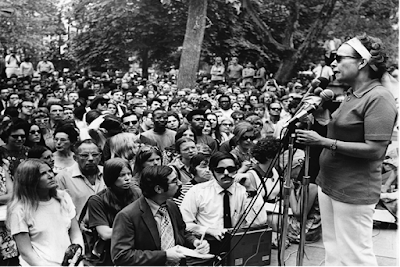
Pennsylvania NOW activist JoAnn Gardner addressing a rally in Philadelphia's Rittenhouse Square

An ever-expanding agenda

Jean Ferson, a skilled organization builder, was elected the second president of Philadelphia NOW at a time of tremendous growth in the feminist movement; fortunately, she was up to the challenge of managing that growth. In December of 1971 national NOW claimed 5,800 members; by the spring of 1973 the number had grown to over 20,000. 24 Most of NOW’s founding members were political/civic activists prior to their involvement in the feminist movement. As the movement broadened in the early 1970s, it drew women who had never before been involved in political activism. Their primary interest was the impact of feminism on their personal lives and they were drawn to the consciousness-raising groups cropping up everywhere. Jean Ferson, a psychologist, was in many ways the ideal person to lead the organization in the early 1970s; unlike some NOW activists, Ferson was very receptive to the rapidly growing consciousness-raising movement.

National NOW and many local NOW chapters initially had an uneasy relationship with the consciousness-raising groups that came to define early 1970s feminism. Many NOW leaders were suspicious of consciousness-raising and some were downright hostile. Pennsylvania NOW activist Beverly Jones argued: “Such groups cannot possibly excel in developing the self-confidence, initiative, and ability of their women … consciousness-raising itself, divorced from the possibility of relevant political activity, cannot operate effectively.”25 The hostility to consciousness-raising was not confined to NOW. Jacqueline Rhodes in Rewriting Radical Women noted that radical women’s liberation groups such as Redstockings and Women’s International Conspiracy from Hell (WITCH) were suspicious of consciousness-raising groups, which some of their members saw as all talk and no action.26

However, local NOW chapters often made their accommodations to consciousness-raising, and some chapter leaders like Jean Ferson enthusiastically embraced these groups. Maren Lockwood Carden speculated, “By the end of 1972, perhaps as many as half of NOW chapters made such sessions an integral part of their overall program.”27 Some NOW chapters built formal ties between the chapter and the consciousness-raising groups; New York City NOW, for example, incorporated consciousness-raising into its committee structure.28 The genius of the chapter model was that it allowed for a range of projects which resonated with local members. And in the early 1970s nothing resonated quite like consciousness-raising.

Ferson acknowledged that the structure of the consciousness-raising group was the antithesis of national NOW with its formal procedures and clear leadership structure, but she saw no problem with NOW’s encouraging and sponsoring these groups. Unlike Beverly Jones, Ferson saw them as a form of political education rather than as a flight from political action:
There were a lot of women who had just been so … brainwashed; they were just beginning to think about certain issues that had never even entered their heads. This was something that we took from the Cultural Revolution in China. They used to have groups of peasants called “Speak Bitterness Groups.”29

Ferson saw consciousness-raising as a form of political education, “trying to get people to think about what they were worth, what they had a right to demand.” She understood that the chapter had to make room for the consciousness-raising movement if it was to meet the needs and expectations of the growing numbers of women eager to join NOW.She managed to maintain the traditional NOW structure at the same time as she encouraged consciousness-raising groups. The chapter was the formally organized political wing, the consciousness-raising group the source of support and sustenance that made political action possible.

Consciousness-raising certainly helped many women free themselves from internalized gender stereotypes and thus become more effective advocates for gender equality. However, groups that were generally seen as “safe spaces” also served to re-enforce race/class divisions. Shirley Geok-lin Lim notes that “safe spaces” are problematic because of “who gets defined outside these spaces” and that women of color, immigrant women, blue collar women whose class and familial positions did not permit them the time to participate, women who did not easily share the cultural values that enabled them to openly discuss ‘the intimate details of their lives’ were much less likely to be invited to participate in consciousness raising groups.Lim recalled:
Living in Cambridge, Massachusetts, I heard my Anglo-European-American college acquaintances plan for baby-sitters and car rides to their women’s groups; but even as a graduate student in a prestigious university, I was never invited to attend one of the many consciousness-raising groups that [Sara] Evans’s history made out to be so democratically accessible.30

Through the early 1970s consciousness-raising groups generally did not reach out to women of color, the groups associated with NOW did reach out to men from members’ social networks. Contrary to the stereotype of man-hating feminism, at both the local and national level NOW welcomed male participation. The October 1970 Philadelphia NOW Newsletter announced the formation of a consciousness-raising husband and wife discussion group as well as an all-male discussion group.31 NOW leaders consistently stressed that individual men were not the enemy; the enemy was the patriarchal system. Men were sometimes damaged by their inability to live up to gender stereotypes and could benefit from the consciousness-raising movement’s challenge to traditional therapy, with its assumption that the patient was ill and that getting well involved adjusting to a sexist society. Rather than relying on an all-powerful doctor prescribing treatment, women [and men] in the consciousness-raising groups struggled to help each other heal.

Feminist anger against the medical establishment was intense. The 1971 Philadelphia NOW Newsletter reported that psychologist Phyllis Chesler called for “$1 million in reparations for the damage done to women via psychotherapy and institutionalization in mental hospitals.”32 Jean Ferson reported that the chapter kept “records of doctors who failed to treat us well … . We wanted a place where you could look up your doctor and find out what kind of rating he got from us. Did he treat women with respect and with dignity?” The chapter did not publicize the information in a formal way, but rather circulated it informally among chapter members. Philadelphia NOW in the early days tried to be both a service and advocacy organization—an unsustainable goal for an organization without paid staff.

Ferson’s personal and professional experiences no doubt played a role in her distrust of the medical establishment and receptiveness to the consciousness-raising movement. In an interview with Philadelphia Inquirer reporter Linda Lloyd, she discussed her struggles with self-doubt and fear that she was ugly. At 27, she earned a doctorate in psychology from the University of Texas, ranking top of her class. She recalled: “Instead of rejoicing and building on it like a man would do without thinking, I got a major depression.” She credits the feminist movement with helping her to win her battle with depression: “I got such support out of NOW, such a feeling of it’s all right! I have allies; I have support.” She described how her personal life had been transformed by feminism and that her relationships with both men and women have improved: “The comfort I feel with men is unexpected, but delightful! And men love it—some of them, that is. Those who want a relationship with another human being instead of a cheering gallery or a servant or a mother.”33 Her five-year marriage ended without rancor, just a sense of disappointment.

Ferson thought she had been recruited by Ernesta Ballard to be the second chapter president because she presented the right image:Ernesta thought I would be a good candidate. First of all, I had finished my degree. I was already divorced—because the movement broke up a lot of marriages. And I had the doctorate and I had a professional job. I probably looked okay. They couldn’t say, ‘Of course she’s a feminist. Look how ugly she is.’ Or something stupid like that.

When Ferson assumed the presidency of Philadelphia NOW, the media was increasingly covering the feminist movement, both nationally and locally. Thanks to her good looks, she generated considerable media interest. Press coverage always stressed her physical attractiveness and usually expressed surprise that a conventionally attractive woman like Ferson would become a liberationist. Even female reporters appeared to share the assumption that there was something surprising about a beautiful woman becoming a feminist. From Linda Lloyd’s profile in the Philadelphia Inquirer:
Dr. Jean Ferson didn’t have to become a liberationist. One basic premise from outside the women’s movement is that women who reject their conventional role—housewife and mother—must be losers who couldn’t play the game, so they want to change it. Jean Ferson, on the other hand, is by all appearances a winner.34

Her good looks and professional success certainly contributed to enhancing the image of NOW that was often seen as an organization of ugly, man-hating harridans.

NOW gave Ferson the courage to pursue her goals and provided validation for her choices. Ferson in turn was loyal to NOW and, convinced that strong organizations were essential to advancing the feminist agenda, she devoted considerable time and energy to organization building. Since Ferson didn’t have children or family responsibilities, she was free to devote considerable time to NOW: “It kind of took over my life rather quickly.” The chapter held two monthly meetings—an educational forum, which Ferson thought at times attracted a hundred people, and chapter business meetings open only to officers and the committee chairs. In addition, the officers ran a Speakers Bureau. According to Ferson, all kinds of local organizations, including men’s service clubs and Rotary Clubs wanted a speaker to explain what NOW all was about. The members who staffed the Speakers Bureau prepared for hostile audiences. Ferson reported: “We had a kind of game we played, ‘Hostile Audience.’ People would come up with insulting kinds of questions. And we would practice how to handle those things. And it was good practice because you would get a certain number of wise guys inevitably.” It is astonishing that all this work was done by volunteers, including volunteers like Ferson with full-time, demanding professional jobs.

Both Ferson’s ferocious work ethic and media savvy were characteristic of many NOW leaders in the 1970s. NOW’s media skills created the illusion that the organization was larger and stronger than it actually was. According to national vice president Toni Carabillo’s report on the first national NOW conference, “When the organizing conference opened, there were actually only about 30 of the 300 members present, though many of us who joined later long had the impression the whole 300 had been in attendance. NOW’s flair for making the few seem many began with this first formal meeting.”35

This ability to conjure up a presence much larger than the organization’s numbers warranted was also noted by the founding members of Philadelphia NOW. Founding member Judy Foley recalled: “One of the things that always amazed me about NOW was that we always had a larger than life image in Philadelphia … even though we were only a little gang.” She recalled someone calling for information about a press release and asking if he could come over to our office and interview me, to which she answered: “It’s really a bad time.” Foley acknowledged: “We didn’t have an office; but there was no way that I was going to let him know that we didn’t have an office. But it just cracked me up because we did have this gigantic image for this little group of people.”36

NOW was concerned both with effective use of the media to advance its agenda and with analysis of the media’s role in upholding sexist institutions. Jean Ferson reported that her most popular committee was the one focused on images of women in the media; women were angry about the hyper-sexualized images of women and the stereotype of the ugly, man-hating feminist. Sexist advertising was a major target of feminist anger, as NOW chapters across the country organized letter-writing campaigns and boycotts against products promoted by sexist ads. Philadelphia NOW published its list of the “Ten Worst Ads of the Year” and urged members to write letters of protest to the ad agencies and sponsoring companies and to boycott the products. Among the ads on the ten worst list were: a print ad for Amelia Earhart Luggage which portrayed a naked woman painted with stripes to match the luggage; a television commercial for Chrysler portraying a mother and daughter looking for a new car in which the mother advises her daughter that she “must not appear bright and capable if she wants to catch a man.”38

Philadelphia NOW’s media savvy activists took on the constant barrage of ridicule directed at feminists, meeting insult with insult. And while anti-feminist tirades are now for the most part limited to the cultural margins, in the early 1970s they were mainstream. The Philadelphia Inquirer in 1971 ran a regular weekly column by Donald C. Drake, Alias “The Gypsy,” appearing in the “For and About Women” section of the paper ridiculing the feminist movement.39 Drake was not the most talented satirist and his point was often lost in his heavy-handed prose, but his animus towards feminism came through loud and clear. Like so many of those attacking feminism, Drake interpreted the demand for equality as a demand for role reversal. On January 8, 1971 Philadelphia NOW awarded Drake the first of its annual “Barefoot and Pregnant” awards for “Male Chauvinism par Excellence.”40 Predictably, Drake used the award as an occasion to heap more ridicule on feminism in general and NOW in particular. However, Drake’s column provided free publicity for NOW, and his columns arguably did more to advance feminist rather than antifeminist attitudes. The Barefoot and Pregnant awards continued through the 1970s, serving as a useful vehicle for attracting new recruits to the chapter. In 1972 the award was accompanied by greater fanfare and went to multiple recipients, among them was the Philadelphia Office of National Airlines for their participation in the sexist “Fly Me” ad campaign.41

Not only did feminists have to deal with rampant sexism and male ridicule of their demands for gender equality; they also had to contend with women who attacked and ridiculed their agenda. The backlash was not, as is sometimes assumed, a phenomenon of the 1980s. The backlash, including female anti-feminism, began as soon as the feminist movement emerged. Before Phyllis Schlafly built an exciting, lucrative career out of arguing that other women should just stay at home, three New York City professional women—Lucianne Goldberg, Jeannie Sakol, and Joan Elbaum Gordon—clearly saw a business opportunity in bashing feminism. They formed an organization, the Pussycat League, to mock the feminist movement and challenge the claim that gender discrimination exists… Criticism of the feminist movement from women writers drew attention. As Elizabeth Duff put it in her Philadelphia Inquirer article on the female backlash against feminism: “Anti-lib articles have popped up like dandelions lately, authored both by movement outsiders and deserters. They are the new ‘in piece’ to write. Backlash is fashionable.”45 Philadelphia NOW’s founding members for the most part viewed the backlash as a measure of their success and continued to utilize the attacks as an opportunity to gain publicity for the feminist movement in general and NOW in particular.

The media’s refusal to treat the feminist movement as newsworthy angered many Philadelphia NOW members. In addition to responding to the barrage of anti-feminist material in the women’s sections of local papers, they also kept up a steady drumbeat of objections to the very existence of a section labeled “For and about Women.” NOW member Babette Newberg [Joseph]’s letter to the Philadelphia Inquirer challenged the rationale behind publishing a separate women’s section. She expressed her dismay that a report of a talk by Gloria Steinem appeared only in the women’s section of the Inquirer and asked the editors: “Would you name a section of your newspaper ‘For and About Blacks’ and report there and only there that Rev. Leon Sullivan endorsed Longstreth for Mayor?”46

NOW chapters combatted the backlash and pursued their agenda with a range of tactics: media campaigns, demonstrations, lobbying campaigns, and where applicable, legal action. Through its Barefoot and Pregnant Award, Philadelphia NOW engaged in a media campaign against the “Fly Me” ad campaign and also held a demonstration in Philadelphia in front of the National Airlines ticket office. Judy Foley reported that the demonstrators had posters with the ad and signs saying “Get Cheryl out of the Back of the Plane;” they gave out the addresses of the advertising agency and of National Airlines and urged people to write to them.47 This was the kind of coordinated strategy Toni Carabillo advocated in which the media message worked in tandem with grassroots actions.

At the same time as NOW members were combating the backlash, they were also trying to build an organization with an ever-expanding agenda. The list of four issues cited in the press release for the 1970 Women’s Equality Day Rally (passage of the Equal Rights Amendment; equality in jobs and education; 24-hour day care facilities; and abortion on demand) had expanded to include divorce reform, women in prison, and women in politics. Also, the childcare issue, which had not received a great deal of attention in Philadelphia NOW’s first year, assumed much greater importance under Jean Ferson’s presidency, no doubt in part because of her profession as a psychologist specializing in child development. Many feminists thought the country was ready to institute a universal childcare program, available to all citizens as a basic right, similar to the programs in European social democracies. Unfortunately, despite widespread public support for childcare, President Nixon vetoed an ambitious federal childcare bill in December 1971. Affordable, high-quality childcare is still part of the unfinished agenda of second-wave feminism.

As was usually the case with NOW chapters across the country, the officers emphasized issues of special importance to them. An issue that received increasing attention during Jean Ferson’s presidency was the plight of incarcerated women. The Pennsylvania State Legislature was considering a bill proposing establishment of community centers as an alternative to incarceration for women convicted of narcotics violations. Ferson, in partnership with the American Association of University Women, organized a Committee for Community Treatment Centers for Women. Their recruitment flyer “SAVE WOMEN FROM JAILS” stated that most women are imprisoned for drug-related offenses and need treatment, not jails. The flyer urged citizens to write to legislators demanding establishment of treatment centers.48 An article in the Philadelphia NOW Newsletter, “Women Come First in Major Jail Reform,” reinforced the message.49 The language of the flyer and newsletter article suggested that women deserved special treatment, based on the presumption than female offenders are primarily victims.

Philadelphia NOW activists in the early 1970s did not appear particularly interested in the argument then raging in feminist theory circles as to whether women are fundamentally similar to men and therefore should be treated equally before the law or whether there are fundamental differences, biologically or culturally driven, which policy makers must take into account. NOW activists did not seem concerned about theoretical consistency and might argue for equal treatment in employment based on women’s fundamental sameness with men, while at the same time arguing for differential treatment in the criminal justice system. Historian Nancy Cott explored the same lack of theoretical consistency on the part of 19th-century feminist activists and characterized this as “a functional ambiguity rather than a debilitating tension.”50 In short, whatever works. Similarly, NOW activists in the early 1970s, overwhelmed with an expanding agenda and operating solely on volunteer energy, were understandably focused on improving women’s lives rather than engaging in theoretical debates about gender difference.

Despite the enormous energy and commitment of Philadelphia NOW’s founders, there were never enough hours in the day, never enough activists to deal with NOW’s lengthening list of priorities. A 1972 memo from Mary Bell Desborough to the Philadelphia NOW officers listed priorities identified by NOW members: Sexist Images of Women in the Media, 37; Employment, 35; Legislation and politics, 30; Abortion: 29; 14 write-ins for childcare centers.51 The records throughout the 1970s suggest that these remained the key issues for most members, with passage of the ERA moving up the list of priority issues as the decade wore on. Although Jean Ferson was clearly committed to addressing the issues of women in prison, she does not appear to have enlisted many chapter members in making this a priority issue. Given the race/class composition of Philadelphia NOW, it is not surprising that women prisoners would not have been a major concern; most members had no one in their families or friendship networks who had been incarcerated.

Jean Ferson described the demographics of Philadelphia NOW as “predominantly white and middle class … and a lot of teachers and professional people.” When asked if the chapter did anything to reach out to women of color and address their issues, Ferson replied: "I don’t think we did much of anything really … we sort of had a full plate as it was. We had enough trouble; we were not looking for it. But, on the national level it came up, and people did more things aggressively with it. But, locally? No, we didn’t do much of anything with it."NOW chapters expanded through the friendship networks of individual members, and in the segregated society of the early 1970s few NOW members had integrated social networks.

Although resolutions addressing the issues of minority and working class women, were passed at the September 1971 national NOWconference, this was not a high priority for national NOW in 1971, nor did these resolutions affect priorities in Philadelphia NOW.54 The August 1972 Women’s Equality Day Celebration organized by Philadelphia NOW in conjunction with other women’s organizations did not include groups led by and/or addressing issues of concern to women of color.55 Locating feminist organizations led by women of color would have been a challenge for Philadelphia NOW members in the early 1970s, especially as they were looking for coalition partners who identified as feminists and explicitly addressed gender issues. The best-known anti-poverty organization, the National Welfare Rights Organization (NWRO), had a strong Philadelphia chapter led by the dynamic Roxanne Jones, who became the first African-American woman elected to the Pennsylvania State Senate. Roxanne Jones’ name does not appear in the Philadelphia NOW newsleNtters of the 1970s, and there appears to have been no connection between NWRO and Philadelphia NOW. However, as Annelise Orleck documents, there were connections between national NOW and welfare rights leader Ruby Duncan, who served for many years on the board of national NOW.56

Philadelphia NOW in the early 1970s did not appear to have had connections (certainly not close connections) with the broader progressive movement; its relationships were primarily with other explicitly feminist organizations. The early 1970s saw a proliferation of organizations advocating for or providing services for women and girls. Many were short-lived and, of the 18 organizations sponsoring the August 25–26, 1972 Women’s Equality Day Celebration, only three have survived. The survivors were local affiliates of national organizations: the League of Women Voters, the National Organization for Women, and the Young Women’s Christian Association (YWCA). The support from national organizations no doubt played a part in the staying power of their Philadelphia affiliates. Furthermore, the organizations with staying power were all structured and hierarchically organized, unlike the loosely organized, evanescent Women’s Liberation groups. Philadelphia NOW members were especially interested in building coalitions with structured, established organizations, like the League of Women Voters. The distrust of coalition work, which surfaced in Pennsylvania NOW and national NOW, was not a concern in the early days of Philadelphia NOW.

Wednesday, March 16, 2022

Feminist Organizing Across the Generations. From Part I, Building the feminist movement: Chapter 1, The founders

Excerpt from Chapter 1 The founders
Ernesta Ballard

The leaders of the second-wave feminist movement, particularly those who were drawn to structured groups such as NOW, were for the most part skilled organization builders, who honed their skills in civic and professional associations, labor unions, and local Democratic Party committees. They were generally older, whiter, and more affluent than the younger women drawn to the Women’s Liberation movement. Although many had experience in grassroots organizations, some of these early leaders had served on the boards of elite organizations and had a network of elite connections. Chapter leaders had a great deal of latitude in deciding which of NOW’s many issues they wanted to foreground. Thus, the issues that particular chapters chose to address were very much bound up with the talents and interests of the leaders.—

The founders of Philadelphia NOW each put their personal stamp on the organization. The founder of Philadelphia NOW, Ernesta Drinker Ballard, born in 1920 into a prominent Philadelphia family, was clearly not the typical founder of a local NOW chapter. Her socialite background and life-long affiliation with the Republican Party notwithstanding, she was a passionate, committed feminist. Such intense commitment usually has some deeply personal source. Ballard told a Philadelphia Inquirer reporter in 1981 that she had wanted to be a lawyer, but that her father “never took it seriously.”1 Although she enjoyed significant class privileges, her options were constrained by the rigid gender roles of her time and class. Despite expectations that she confine herself to a life as wife and mother, Ballard managed to build a successful horticultural business and transform the Pennsylvania Horticultural Society into a world-class organization. When the feminist movement burst on the scene in the late 1960s, Ballard found her calling and dedicated her considerable talents in organization building to Philadelphia NOW.

The first president of Philadelphia NOW was not elected until 1970. Ballard clearly wanted to be part of the feminist movement but, whether as a consequence of her elite background or personal reticence (or both), she did not want to be the public face of the chapter and recruited Mary Lynne Speers as the chapter’s first president and Jean Ferson as its second. In a 2004 interview, Ballard described her role in forming Philadelphia NOW:
The way I got into it is kind of funny … . My mother was living with us and she was very ill; she was dying of cancer. She got a letter from Betty Friedan, and Betty’s letter said that she heard about my mother because my mother had written a book about music and women … and Betty said, ‘I’m forming this new organization called the National Organization for Women.’ And she wanted mother to go onto the board.

Ballard wrote to Friedan and said that her mother “would’ve been so thrilled to have been invited, but she can’t. She’s dead. If there’s anything I can do to help you, let me know.” Friedan called her to say: “I’m sorry about your mother. But will you do it? You’ll be fine. We’re looking for … Mainline, you know, establishment sort of a person.” Ballard readily accepted the invitation: “I was definitely a feminist, and I was thrilled to be asked.” However, she was concerned about a conflict with her position at the Pennsylvania Horticulture Society, and worried that feminism and horticulture didn’t “really mix very well.” She reported receiving critical letters, mostly from men, asking her “Why don’t you stick to your petunias?”2

Friedan was very interested in recruiting rich, well-connected women like Ballard, both for their access to financial resources and for what she saw as their ability to lend credibility to the fledgling organization. Although Friedan is often credited with launching a broad-based, grassroots movement, that was apparently not her original intention. Political scientist Jo Freeman has noted that some of NOW’s initiators like Friedan were “very high-powered women who lacked the time or patience for the slow, unglamorous work of putting together a mass organization.”3 Susan Brownmiller reported that Friedan rejected her application for membership because she did not fit the model of the successful professional woman Friedan was trying to recruit.4 However, Friedan’s original conception quickly evolved as women around the country expressed interest in forming local chapters.

Ernesta Ballard served for a year on the national NOW board and was the driving force behind the formation of the Philadelphia chapter. She reported: “Then, it came the time to really be formalized and say we have a structure and a president. And I said, ‘Look, I really can’t do it.’ It was going to interfere with my job and the media publicity … . It just wouldn’t work. So, I sort of stepped aside.” Although Mary Lynne Speers, a 28-year-old woman who aspired to go to law school, was Philadelphia NOW’s first president, Ballard was generally acknowledged to be the prime mover. According to Philadelphia NOW’s second president, Jean Ferson: “The woman who really started all this in Philadelphia was Ernesta Drinker Ballard.”5

Unlike her hero, suffragist Alice Paul, Ernesta Ballard was not accustomed to public demonstrations; it was not the way she and the people in her social networks got things done. However, when asked by Speers to participate in a 1970 vigil at the Capitol to bring the Equal Rights Amendment to the floor of Congress for a vote, she appears not to have hesitated. Ballard and Speers took the train to Washington and went to the Capitol:
And we were relieved that there were people on the steps. There weren’t that many. Three of us and maybe four or five others. Not many people paid attention to us, but we stayed there the whole night. And that was a little adventure. At about 6 or 7 o’clock some people came to relieve us. And we went to the station, got on the train, and went home.

Ballard recalled she knew the story would be in the newspapers when reporter Rose DeWolf called and said she heard that Ballard had spent the night in Washington.

The tone of Ballard’s 2004 recollection of the vigil contrasted sharply with her much less positive account reported by DeWolf the day after the event. During the 2004 interview Ballard recalled the event as an adventure and was clearly proud of the role she played. In the interview for DeWolf’s 1970 article, however, Ballard portrayed the vigil as a disappointment: “Do you know how many women were there, standing vigil? Four, that’s all. Why didn’t women come? There have been huge crowds when the issue was peace or civil rights. Don’t women care?” Mary Lynne Speers groped for an explanation: “Maybe women are just programmed to work for others, not themselves … . Or maybe they’re just tired of demonstrations…” Ballard raised questions about the wisdom of holding the event: “Maybe they were afraid to stay out at night. Maybe it was just our strategy that was wrong … maybe a 24-hour vigil just isn’t the way to make the point.”6 Another reason, no doubt, was that Philadelphia NOW’s founders did not have the resources to mobilize large numbers of people for demonstrations. Despite these setbacks, the founding members I interviewed clearly viewed the feminist movement as one of the peak experiences of their lives, and many, like Ballard, recalled the excitement and sense of solidarity much more vividly than the drudgery and disappointments
.
Participation in demonstrations and vigils may not have come naturally to Ernesta Ballard. What did come naturally was using her social contacts to put pressure on powerful interests to open opportunities for women. One of Philadelphia NOW’s first and most successful actions was challenging the sexist assumptions underlying a local job fair called Operation Native Son, sponsored by the Greater Philadelphia Chamber of Commerce. Once a year, the Chamber of Commerce provided an opportunity for Pennsylvanians attending college outside the state to be interviewed by prospective employers from the Philadelphia area. The program was blatantly discriminatory against women. According to Philadelphia NOW’s second president Jean Ferson:
Operation Native Son was something that drove Ernesta nuts … . [She said,] ‘We need to change that name.’ And we did … we got the name changed. And there was a tremendous concern around that time in terms of how language was used to discriminate against women or to insult women, and we wanted people to get more aware of that.

When told that Jean Ferson had credited her with the victory, Ernesta Ballard downplayed her role: “Well, I was writing letters. Thatcher [Longstreth, the Chamber of Commerce president] was a friend of mine, so I said we have to do something about this.”

Philadelphia NOW won the battle, but it’s not clear who or what gets credit for the victory. NOW’ s letter writing campaign? The threat of legal action? Ernesta Ballard’s behind the scenes lobbying? No doubt, all of the above. And it is certainly possible that the Chamber of Commerce realized the times had changed and locking women out of job fairs was no longer an option. The files of founding member Judy Foley included, along with news clippings about NOW’s protests against Operation Native Son, Foley’s handwritten note: “Ernesta talked to Longstreth. He’s sympathetic—tried to get it changed before.” Perhaps Longstreth welcomed the pressure from NOW, which made it easier for him to change course. For Ernesta Ballard and the other founding members of Philadelphia NOW, their modus operandi for ending discriminatory practices included letter-writing campaigns to public officials and business leaders, threats of legal action, and using their personal connections for behind-the-scenes persuasion. They were not yet utilizing such tactics as mass rallies and never even considered civil disobedience. In this respect, they were very much in accord with the tactics of national NOW in its early years.

Ending discrimination in employment and enforcing “equal pay for equal work” were clearly national NOW’s top priorities in the late 1960s and early 1970s. According to Ernesta Ballard’s daughter Alice, her mother strongly disagreed with the national NOW board’s initial reluctance in the 1960s to champion abortion rights and lesbian rights, the two issues Alice Ballard recalled her mother was most passionate about.8 In response to pressure from members such as Ernesta Ballard, National NOW expanded its agenda and by 1971 was on record in support of both abortion rights and lesbian rights.

However, on both national and local levels, the activist energy in the late 1960s and early 1970s focused on ending discrimination in employment. NOW was determined to end the practice of dividing classified ads into “Help Wanted for Men” and “Help Wanted for Women.” While some feminists would organize demonstrations and others would initiate legal action, Ernesta Ballard protested directly to those in power. After all, as she said, many of these people were members of her social circle. According to Ballard:
The editor of the Philadelphia Bulletin, Bobby Taylor, was a friend of mine. I wrote a letter to him and said, ‘You know, this is terrible!’ He said they felt that what they were doing was right and fair and appropriate. He didn’t need any advice. It was a snooty, snooty letter. But it gradually did begin to change.

Ballard knew where she had leverage and continued to pressure the local elite to end discriminatory practices and the ridicule of the feminist movement then filling the editorial pages.
The June 1973 Philadelphia NOW Newsletter recounts her outraged response to an appallingly sexist article, ‘Why Can’t a Woman Be like a Woman?” in the Delaware Valley Business Fortnight written by Myles Standish. (Yes, that really was his name, not a pseudonym, as I originally thought.) The fact that a respectable business journal thought it fit to publish this article speaks volumes about the climate of opinion in the early 1970s. From Standish’s article, quoted in full in the Philadelphia NOW Newsletter:
It is difficult for me to see the masculine allure in an alleged male, wearing feminine, hip-hugging trousers over platform shoes made of a Joseph’s coat collection of colored leathers! Seemingly, the gay boys who got their revenge on the gals by making them look totally ridiculous in the clothes the gays designed for them, are trying to wreak the same sort of revenge on the men…9

Standish associates the break down in rigid gender roles with homosexuality—a common theme in the early 1970s reaction against feminism. Also, quite typical was Standish’s sense that demands for gender equality were really a cover for a drive for dominance over men. He further argues that deviation from traditional gender “leads inevitably to the unhappiness of the female. And I have rarely seen more unhappy women at all age levels than in the United States.”10
Blaming feminism rather than sexism for the unhappiness of American women must have enraged Ernesta Ballard. The Philadelphia NOW Newsletter reprinted her letter to Thatcher Longstreth, president of the Philadelphia Chamber of Commerce:
As an old friend, and one has been fair to women, I am asking you to read the editorial in the Business Fortnight and ask yourself: Does it go out of its way to belittle women? Does it go out of its way to insult homosexuals? Does it belong in Business Fortnight? Does it represent the view of the Chamber of Commerce?

The Philadelphia NOW Newsletter also printed Longstreth’s response. Despite a reference to the “garbage” coming from “Women’s Lib extremists,” his reply suggested that he was more advanced than most men from his background and generation. The newsletter’s record of the correspondence ends with the injunction: LETTER WRITERS, PICK UP YOUR PENS!11 Philadelphia NOW members at this point were not taking to the streets, but using all the insider tactics at their disposal to end discrimination against women.
Would Philadelphia NOW have been successful in getting the Chamber of Commerce to change its policies regarding Operation Native Son and its inclusion of blatantly sexist articles in its publications without Ernesta Ballard’s guiding hand and determination? My guess is it would not have happened so quickly. Ballard excelled in political persuasion and organization building—marshaling resources, securing funding, gaining the support of powerful opinion leaders—skills she had acquired though the volunteer work expected of women of her social class. Although Ernesta Ballard cultivated relationships with the local elite, her name does not appear in the documents pertaining to Philadelphia NOW’s members’ early forays into partisan politics. She does not appear to have been directly involved in the formation of the Philadelphia branch of the National Women’s Political Caucus in 1971. In the early 1970s, her public political involvement appears to have been largely confined to non-partisan civic organizations such as the League of Women Voters. Ballard’s lack of direct involvement in Philadelphia partisan politics on behalf of feminist issues in the early 1970s is no doubt in part due to her affiliation with the Republican Party. In the 1970s a political realignment was beginning to occur, and Republicans were becoming increasingly marginalized in city politics. Both nationally and locally the Democratic Party was becoming the political home of the feminist movement.
In my 2004 interview with Ballard, she bemoaned the change in her party. My guess is if she had lived, she would have left the party that had left her: “I stay Republican, partly out of stubbornness. Why should I quit … . There are a lot of moderate Republicans. We had a national organization about Republican Majority for Choice.” She wanted to go back to what she saw as the traditional Republican Party: “liberty, privacy, small government, national defense. You know they’re all good things. You couldn’t fault them.” Ballard saw no contradiction between equality for all women and the “small government” philosophy of the Republican Party. For her, feminism meant dismantling the legal barriers to women’s advancement in employment and education and safeguarding a woman’s reproductive rights; it did not include a commitment to a Scandinavian-style safety net.

As the feminist movement grew and became increasingly diverse, more feminists began to see a robust safety net funded by progressive taxation as essential for gender equality. Most of the women Ernesta Ballard worked with in the feminist movement were Democrats, advocates of government-funded social programs rather than the “small government” Ballard advocated; thus, maintaining distance from partisan politics was a way of avoiding conflict with her feminist allies. Ballard’s name appears in the membership lists of the National Women’s Political Caucus, a chapter of which was formed in Philadelphia in 1971, but the minutes do not indicate that she played a major role in the group. Her name generally does not appear in accounts of local public demonstrations—the 1970 vigil at the Capitol steps was a rare public protest for her.

Perhaps it was easier for her to engage in public protests when she was out of town. One of the few public feminist campaigns she was involved was the 1981 national NOW campaign to send feminist missionaries to Utah, the heart of the opposition to Equal Rights Amendment; they were to take the message of the ERA directly to the Mormon people, door to door. Ballard had just retired as executive director of the Philadelphia Horticultural Society and perhaps felt more comfortable engaging in overt political activity and activities such as door-to-door canvasing, but it was not something that came naturally to her.

During my 2004 interview with Ballard she recalled that she was canvasing in a “beautiful development.” When she rang a doorbell, the woman who opened the door asked, “Ernesta! What are you doing here?” Ballard remembered that the woman was on the board of the Garden Federation of the United States of America when Ballard was their horticulture chair. Ballard recalled: “She remembered me and said, ‘Come in. Come in.’ And she showed us her garden in the back, and I finally said, ‘I have to tell you why we’re here.” The woman replied: “I know why you’re here. I can see your buttons and everything. I can’t really do anything to help you, but give me your literature.” Ballard had not expected such a friendly reception and she was clearly moved by the woman’s response. Just as Ballard’s 2004 recollections of the 1970 Washington ERA vigil were more positive than her account reported the day after the event in the Philadelphia Bulletin, Ballard’s 2004 recollections of her involvement in the Missionaries to the Mormons campaign focused on positive memories in sharp contrast to the feelings she expressed to an Inquirer reporter at the time of campaign.

However, despite the hostile reaction from most of the Mormons, Ernesta Ballard did not regret participating in the campaign. During her stay she sent a postcard to the then president of Philadelphia NOW Doris Pechkurow: “I really feel like a martyr. It’s HOT, exhausting and we’re not popular! But the other missionaries are wonderful and the experience is one I wouldn’t have wanted to have missed.”12 Women from Ballard’s social world were not accustomed to the anger and rejection she experienced in Utah. In the final days of the campaign for the ERA, NOW had become more militant, more reliant on tactics like mass demonstrations and door-to-door canvassing, very different from the behind-the-scenes organizing that characterized Ballard’s participation in the early days of Philadelphia NOW. Ballard was a skilled organizer, but her tactics were usually the mainstream tactics she had learned in establishment philanthropic organizations. Her willingness to go beyond her comfort level and participate in the Missionaries to the Mormons campaign is surely an indication of the depth of her commitment to the passage of the ERA…

Philadelphia was a very segregated city in the 1960s and 1970s; unsurprisingly, the local NOW chapter reflected this. NOW chapters expanded through the social networks of the founders, and as they acknowledged, those networks were largely white and middle class. Although not expressed explicitly, the founders’ comments suggested that they just did not know how to develop ties with women from different racial backgrounds. Ballard told an Inquirer reporter that recognizing her own oppression as a woman enabled her to understand and overcome racial prejudice. Born in 1920, she grew up at a time when racial and religious prejudices were the norm. She recalled: “My grandmother used to say, ‘Always remember Ernesta, there are two really wicked things in life—whiskey and the Pope.’ And Blacks—when I grew up they were servants; they weren’t people. It took a while to get used to the idea that Jews and Blacks were people just like me, and I could love them. The moment of truth came when I began to realize that women too were discriminated against.”19 Very few women of Ballard’s generation and socio-economic background made this intellectual and emotional journey…

It was not just white affluent NOW members who had difficulty reaching across the racial divide. Feminist historian Alice Echols’ report on the first Women’s Liberation conference at Sandy Springs, Maryland in 1968 includes a transcript of a discussion on Black women and the Women’s Liberation movement. The transcript does not support the Women’s Liberation movement’s reputation for being the more radical strand of the movement and makes for uncomfortable reading from a 21st-century vantage point, revealing to what extent even the most progressive members of society lived in a segregated world, with little experience outside their racial group. From the transcript: “ok … I have problems dealing with Black people; I think everyone in this room does, with men or women. I think if we are really honest about it we don’t want to work with Black women because we are not sure what our relationship is.”20 Some members of the group did want to include Black women; most saw such outreach as problematic and were wary of doing so.

References both to racial discrimination and to the Vietnam War were generally absent from the NOW documents from the late 1960s and early 1970s. However, reflecting the growing influence of the anti-war movement on the feminist movement, in 1971 national NOW changed course and passed an anti-war resolution calling for an immediate end to all American military activity in Southeast Asia.23 National NOW has historically been ahead of local chapters in recognizing the connection of gender issues with other struggles for social justice. The 1971 resolution apparently did not have a major impact on Philadelphia NOW Philadelphia NOW in the early years was focused almost exclusively on women’s rights. The road to becoming an intersectional feminist organization would be a long and rocky one.