Friday, March 18, 2022
Feminist Organizing Across the Generations. Part I, Building the feminist movement: Chapter 1, An Ever-Expanding Agenda
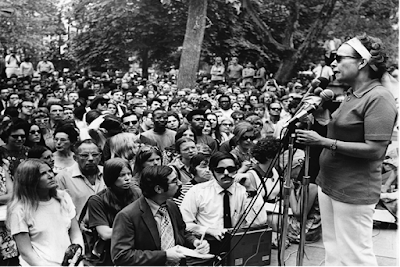
Pennsylvania NOW activist JoAnn Gardner addressing a rally in Philadelphia's Rittenhouse Square
An ever-expanding agenda
Jean Ferson, a skilled organization builder, was elected the second president of Philadelphia NOW at a time of tremendous growth in the feminist movement; fortunately, she was up to the challenge of managing that growth. In December of 1971 national NOW claimed 5,800 members; by the spring of 1973 the number had grown to over 20,000. 24 Most of NOW’s founding members were political/civic activists prior to their involvement in the feminist movement. As the movement broadened in the early 1970s, it drew women who had never before been involved in political activism. Their primary interest was the impact of feminism on their personal lives and they were drawn to the consciousness-raising groups cropping up everywhere. Jean Ferson, a psychologist, was in many ways the ideal person to lead the organization in the early 1970s; unlike some NOW activists, Ferson was very receptive to the rapidly growing consciousness-raising movement.
National NOW and many local NOW chapters initially had an uneasy relationship with the consciousness-raising groups that came to define early 1970s feminism. Many NOW leaders were suspicious of consciousness-raising and some were downright hostile. Pennsylvania NOW activist Beverly Jones argued: “Such groups cannot possibly excel in developing the self-confidence, initiative, and ability of their women … consciousness-raising itself, divorced from the possibility of relevant political activity, cannot operate effectively.”25 The hostility to consciousness-raising was not confined to NOW. Jacqueline Rhodes in Rewriting Radical Women noted that radical women’s liberation groups such as Redstockings and Women’s International Conspiracy from Hell (WITCH) were suspicious of consciousness-raising groups, which some of their members saw as all talk and no action.26
However, local NOW chapters often made their accommodations to consciousness-raising, and some chapter leaders like Jean Ferson enthusiastically embraced these groups. Maren Lockwood Carden speculated, “By the end of 1972, perhaps as many as half of NOW chapters made such sessions an integral part of their overall program.”27 Some NOW chapters built formal ties between the chapter and the consciousness-raising groups; New York City NOW, for example, incorporated consciousness-raising into its committee structure.28 The genius of the chapter model was that it allowed for a range of projects which resonated with local members. And in the early 1970s nothing resonated quite like consciousness-raising.
Ferson acknowledged that the structure of the consciousness-raising group was the antithesis of national NOW with its formal procedures and clear leadership structure, but she saw no problem with NOW’s encouraging and sponsoring these groups. Unlike Beverly Jones, Ferson saw them as a form of political education rather than as a flight from political action:
There were a lot of women who had just been so … brainwashed; they were just beginning to think about certain issues that had never even entered their heads. This was something that we took from the Cultural Revolution in China. They used to have groups of peasants called “Speak Bitterness Groups.”29
Ferson saw consciousness-raising as a form of political education, “trying to get people to think about what they were worth, what they had a right to demand.” She understood that the chapter had to make room for the consciousness-raising movement if it was to meet the needs and expectations of the growing numbers of women eager to join NOW.She managed to maintain the traditional NOW structure at the same time as she encouraged consciousness-raising groups. The chapter was the formally organized political wing, the consciousness-raising group the source of support and sustenance that made political action possible.
Consciousness-raising certainly helped many women free themselves from internalized gender stereotypes and thus become more effective advocates for gender equality. However, groups that were generally seen as “safe spaces” also served to re-enforce race/class divisions. Shirley Geok-lin Lim notes that “safe spaces” are problematic because of “who gets defined outside these spaces” and that women of color, immigrant women, blue collar women whose class and familial positions did not permit them the time to participate, women who did not easily share the cultural values that enabled them to openly discuss ‘the intimate details of their lives’ were much less likely to be invited to participate in consciousness raising groups.Lim recalled:
Living in Cambridge, Massachusetts, I heard my Anglo-European-American college acquaintances plan for baby-sitters and car rides to their women’s groups; but even as a graduate student in a prestigious university, I was never invited to attend one of the many consciousness-raising groups that [Sara] Evans’s history made out to be so democratically accessible.30
Through the early 1970s consciousness-raising groups generally did not reach out to women of color, the groups associated with NOW did reach out to men from members’ social networks. Contrary to the stereotype of man-hating feminism, at both the local and national level NOW welcomed male participation. The October 1970 Philadelphia NOW Newsletter announced the formation of a consciousness-raising husband and wife discussion group as well as an all-male discussion group.31 NOW leaders consistently stressed that individual men were not the enemy; the enemy was the patriarchal system. Men were sometimes damaged by their inability to live up to gender stereotypes and could benefit from the consciousness-raising movement’s challenge to traditional therapy, with its assumption that the patient was ill and that getting well involved adjusting to a sexist society. Rather than relying on an all-powerful doctor prescribing treatment, women [and men] in the consciousness-raising groups struggled to help each other heal.
Feminist anger against the medical establishment was intense. The 1971 Philadelphia NOW Newsletter reported that psychologist Phyllis Chesler called for “$1 million in reparations for the damage done to women via psychotherapy and institutionalization in mental hospitals.”32 Jean Ferson reported that the chapter kept “records of doctors who failed to treat us well … . We wanted a place where you could look up your doctor and find out what kind of rating he got from us. Did he treat women with respect and with dignity?” The chapter did not publicize the information in a formal way, but rather circulated it informally among chapter members. Philadelphia NOW in the early days tried to be both a service and advocacy organization—an unsustainable goal for an organization without paid staff.
Ferson’s personal and professional experiences no doubt played a role in her distrust of the medical establishment and receptiveness to the consciousness-raising movement. In an interview with Philadelphia Inquirer reporter Linda Lloyd, she discussed her struggles with self-doubt and fear that she was ugly. At 27, she earned a doctorate in psychology from the University of Texas, ranking top of her class. She recalled: “Instead of rejoicing and building on it like a man would do without thinking, I got a major depression.” She credits the feminist movement with helping her to win her battle with depression: “I got such support out of NOW, such a feeling of it’s all right! I have allies; I have support.” She described how her personal life had been transformed by feminism and that her relationships with both men and women have improved: “The comfort I feel with men is unexpected, but delightful! And men love it—some of them, that is. Those who want a relationship with another human being instead of a cheering gallery or a servant or a mother.”33 Her five-year marriage ended without rancor, just a sense of disappointment.
Ferson thought she had been recruited by Ernesta Ballard to be the second chapter president because she presented the right image:Ernesta thought I would be a good candidate. First of all, I had finished my degree. I was already divorced—because the movement broke up a lot of marriages. And I had the doctorate and I had a professional job. I probably looked okay. They couldn’t say, ‘Of course she’s a feminist. Look how ugly she is.’ Or something stupid like that.
When Ferson assumed the presidency of Philadelphia NOW, the media was increasingly covering the feminist movement, both nationally and locally. Thanks to her good looks, she generated considerable media interest. Press coverage always stressed her physical attractiveness and usually expressed surprise that a conventionally attractive woman like Ferson would become a liberationist. Even female reporters appeared to share the assumption that there was something surprising about a beautiful woman becoming a feminist. From Linda Lloyd’s profile in the Philadelphia Inquirer:
Dr. Jean Ferson didn’t have to become a liberationist. One basic premise from outside the women’s movement is that women who reject their conventional role—housewife and mother—must be losers who couldn’t play the game, so they want to change it. Jean Ferson, on the other hand, is by all appearances a winner.34
Her good looks and professional success certainly contributed to enhancing the image of NOW that was often seen as an organization of ugly, man-hating harridans.
NOW gave Ferson the courage to pursue her goals and provided validation for her choices. Ferson in turn was loyal to NOW and, convinced that strong organizations were essential to advancing the feminist agenda, she devoted considerable time and energy to organization building. Since Ferson didn’t have children or family responsibilities, she was free to devote considerable time to NOW: “It kind of took over my life rather quickly.” The chapter held two monthly meetings—an educational forum, which Ferson thought at times attracted a hundred people, and chapter business meetings open only to officers and the committee chairs. In addition, the officers ran a Speakers Bureau. According to Ferson, all kinds of local organizations, including men’s service clubs and Rotary Clubs wanted a speaker to explain what NOW all was about. The members who staffed the Speakers Bureau prepared for hostile audiences. Ferson reported: “We had a kind of game we played, ‘Hostile Audience.’ People would come up with insulting kinds of questions. And we would practice how to handle those things. And it was good practice because you would get a certain number of wise guys inevitably.” It is astonishing that all this work was done by volunteers, including volunteers like Ferson with full-time, demanding professional jobs.
Both Ferson’s ferocious work ethic and media savvy were characteristic of many NOW leaders in the 1970s. NOW’s media skills created the illusion that the organization was larger and stronger than it actually was. According to national vice president Toni Carabillo’s report on the first national NOW conference, “When the organizing conference opened, there were actually only about 30 of the 300 members present, though many of us who joined later long had the impression the whole 300 had been in attendance. NOW’s flair for making the few seem many began with this first formal meeting.”35
This ability to conjure up a presence much larger than the organization’s numbers warranted was also noted by the founding members of Philadelphia NOW. Founding member Judy Foley recalled: “One of the things that always amazed me about NOW was that we always had a larger than life image in Philadelphia … even though we were only a little gang.” She recalled someone calling for information about a press release and asking if he could come over to our office and interview me, to which she answered: “It’s really a bad time.” Foley acknowledged: “We didn’t have an office; but there was no way that I was going to let him know that we didn’t have an office. But it just cracked me up because we did have this gigantic image for this little group of people.”36
NOW was concerned both with effective use of the media to advance its agenda and with analysis of the media’s role in upholding sexist institutions. Jean Ferson reported that her most popular committee was the one focused on images of women in the media; women were angry about the hyper-sexualized images of women and the stereotype of the ugly, man-hating feminist. Sexist advertising was a major target of feminist anger, as NOW chapters across the country organized letter-writing campaigns and boycotts against products promoted by sexist ads. Philadelphia NOW published its list of the “Ten Worst Ads of the Year” and urged members to write letters of protest to the ad agencies and sponsoring companies and to boycott the products. Among the ads on the ten worst list were: a print ad for Amelia Earhart Luggage which portrayed a naked woman painted with stripes to match the luggage; a television commercial for Chrysler portraying a mother and daughter looking for a new car in which the mother advises her daughter that she “must not appear bright and capable if she wants to catch a man.”38
Philadelphia NOW’s media savvy activists took on the constant barrage of ridicule directed at feminists, meeting insult with insult. And while anti-feminist tirades are now for the most part limited to the cultural margins, in the early 1970s they were mainstream. The Philadelphia Inquirer in 1971 ran a regular weekly column by Donald C. Drake, Alias “The Gypsy,” appearing in the “For and About Women” section of the paper ridiculing the feminist movement.39 Drake was not the most talented satirist and his point was often lost in his heavy-handed prose, but his animus towards feminism came through loud and clear. Like so many of those attacking feminism, Drake interpreted the demand for equality as a demand for role reversal. On January 8, 1971 Philadelphia NOW awarded Drake the first of its annual “Barefoot and Pregnant” awards for “Male Chauvinism par Excellence.”40 Predictably, Drake used the award as an occasion to heap more ridicule on feminism in general and NOW in particular. However, Drake’s column provided free publicity for NOW, and his columns arguably did more to advance feminist rather than antifeminist attitudes. The Barefoot and Pregnant awards continued through the 1970s, serving as a useful vehicle for attracting new recruits to the chapter. In 1972 the award was accompanied by greater fanfare and went to multiple recipients, among them was the Philadelphia Office of National Airlines for their participation in the sexist “Fly Me” ad campaign.41
Not only did feminists have to deal with rampant sexism and male ridicule of their demands for gender equality; they also had to contend with women who attacked and ridiculed their agenda. The backlash was not, as is sometimes assumed, a phenomenon of the 1980s. The backlash, including female anti-feminism, began as soon as the feminist movement emerged. Before Phyllis Schlafly built an exciting, lucrative career out of arguing that other women should just stay at home, three New York City professional women—Lucianne Goldberg, Jeannie Sakol, and Joan Elbaum Gordon—clearly saw a business opportunity in bashing feminism. They formed an organization, the Pussycat League, to mock the feminist movement and challenge the claim that gender discrimination exists… Criticism of the feminist movement from women writers drew attention. As Elizabeth Duff put it in her Philadelphia Inquirer article on the female backlash against feminism: “Anti-lib articles have popped up like dandelions lately, authored both by movement outsiders and deserters. They are the new ‘in piece’ to write. Backlash is fashionable.”45 Philadelphia NOW’s founding members for the most part viewed the backlash as a measure of their success and continued to utilize the attacks as an opportunity to gain publicity for the feminist movement in general and NOW in particular.
The media’s refusal to treat the feminist movement as newsworthy angered many Philadelphia NOW members. In addition to responding to the barrage of anti-feminist material in the women’s sections of local papers, they also kept up a steady drumbeat of objections to the very existence of a section labeled “For and about Women.” NOW member Babette Newberg [Joseph]’s letter to the Philadelphia Inquirer challenged the rationale behind publishing a separate women’s section. She expressed her dismay that a report of a talk by Gloria Steinem appeared only in the women’s section of the Inquirer and asked the editors: “Would you name a section of your newspaper ‘For and About Blacks’ and report there and only there that Rev. Leon Sullivan endorsed Longstreth for Mayor?”46
NOW chapters combatted the backlash and pursued their agenda with a range of tactics: media campaigns, demonstrations, lobbying campaigns, and where applicable, legal action. Through its Barefoot and Pregnant Award, Philadelphia NOW engaged in a media campaign against the “Fly Me” ad campaign and also held a demonstration in Philadelphia in front of the National Airlines ticket office. Judy Foley reported that the demonstrators had posters with the ad and signs saying “Get Cheryl out of the Back of the Plane;” they gave out the addresses of the advertising agency and of National Airlines and urged people to write to them.47 This was the kind of coordinated strategy Toni Carabillo advocated in which the media message worked in tandem with grassroots actions.
At the same time as NOW members were combating the backlash, they were also trying to build an organization with an ever-expanding agenda. The list of four issues cited in the press release for the 1970 Women’s Equality Day Rally (passage of the Equal Rights Amendment; equality in jobs and education; 24-hour day care facilities; and abortion on demand) had expanded to include divorce reform, women in prison, and women in politics. Also, the childcare issue, which had not received a great deal of attention in Philadelphia NOW’s first year, assumed much greater importance under Jean Ferson’s presidency, no doubt in part because of her profession as a psychologist specializing in child development. Many feminists thought the country was ready to institute a universal childcare program, available to all citizens as a basic right, similar to the programs in European social democracies. Unfortunately, despite widespread public support for childcare, President Nixon vetoed an ambitious federal childcare bill in December 1971. Affordable, high-quality childcare is still part of the unfinished agenda of second-wave feminism.
As was usually the case with NOW chapters across the country, the officers emphasized issues of special importance to them. An issue that received increasing attention during Jean Ferson’s presidency was the plight of incarcerated women. The Pennsylvania State Legislature was considering a bill proposing establishment of community centers as an alternative to incarceration for women convicted of narcotics violations. Ferson, in partnership with the American Association of University Women, organized a Committee for Community Treatment Centers for Women. Their recruitment flyer “SAVE WOMEN FROM JAILS” stated that most women are imprisoned for drug-related offenses and need treatment, not jails. The flyer urged citizens to write to legislators demanding establishment of treatment centers.48 An article in the Philadelphia NOW Newsletter, “Women Come First in Major Jail Reform,” reinforced the message.49 The language of the flyer and newsletter article suggested that women deserved special treatment, based on the presumption than female offenders are primarily victims.
Philadelphia NOW activists in the early 1970s did not appear particularly interested in the argument then raging in feminist theory circles as to whether women are fundamentally similar to men and therefore should be treated equally before the law or whether there are fundamental differences, biologically or culturally driven, which policy makers must take into account. NOW activists did not seem concerned about theoretical consistency and might argue for equal treatment in employment based on women’s fundamental sameness with men, while at the same time arguing for differential treatment in the criminal justice system. Historian Nancy Cott explored the same lack of theoretical consistency on the part of 19th-century feminist activists and characterized this as “a functional ambiguity rather than a debilitating tension.”50 In short, whatever works. Similarly, NOW activists in the early 1970s, overwhelmed with an expanding agenda and operating solely on volunteer energy, were understandably focused on improving women’s lives rather than engaging in theoretical debates about gender difference.
Despite the enormous energy and commitment of Philadelphia NOW’s founders, there were never enough hours in the day, never enough activists to deal with NOW’s lengthening list of priorities. A 1972 memo from Mary Bell Desborough to the Philadelphia NOW officers listed priorities identified by NOW members: Sexist Images of Women in the Media, 37; Employment, 35; Legislation and politics, 30; Abortion: 29; 14 write-ins for childcare centers.51 The records throughout the 1970s suggest that these remained the key issues for most members, with passage of the ERA moving up the list of priority issues as the decade wore on. Although Jean Ferson was clearly committed to addressing the issues of women in prison, she does not appear to have enlisted many chapter members in making this a priority issue. Given the race/class composition of Philadelphia NOW, it is not surprising that women prisoners would not have been a major concern; most members had no one in their families or friendship networks who had been incarcerated.
Jean Ferson described the demographics of Philadelphia NOW as “predominantly white and middle class … and a lot of teachers and professional people.” When asked if the chapter did anything to reach out to women of color and address their issues, Ferson replied: "I don’t think we did much of anything really … we sort of had a full plate as it was. We had enough trouble; we were not looking for it. But, on the national level it came up, and people did more things aggressively with it. But, locally? No, we didn’t do much of anything with it."NOW chapters expanded through the friendship networks of individual members, and in the segregated society of the early 1970s few NOW members had integrated social networks.
Although resolutions addressing the issues of minority and working class women, were passed at the September 1971 national NOWconference, this was not a high priority for national NOW in 1971, nor did these resolutions affect priorities in Philadelphia NOW.54 The August 1972 Women’s Equality Day Celebration organized by Philadelphia NOW in conjunction with other women’s organizations did not include groups led by and/or addressing issues of concern to women of color.55 Locating feminist organizations led by women of color would have been a challenge for Philadelphia NOW members in the early 1970s, especially as they were looking for coalition partners who identified as feminists and explicitly addressed gender issues. The best-known anti-poverty organization, the National Welfare Rights Organization (NWRO), had a strong Philadelphia chapter led by the dynamic Roxanne Jones, who became the first African-American woman elected to the Pennsylvania State Senate. Roxanne Jones’ name does not appear in the Philadelphia NOW newsleNtters of the 1970s, and there appears to have been no connection between NWRO and Philadelphia NOW. However, as Annelise Orleck documents, there were connections between national NOW and welfare rights leader Ruby Duncan, who served for many years on the board of national NOW.56
Philadelphia NOW in the early 1970s did not appear to have had connections (certainly not close connections) with the broader progressive movement; its relationships were primarily with other explicitly feminist organizations. The early 1970s saw a proliferation of organizations advocating for or providing services for women and girls. Many were short-lived and, of the 18 organizations sponsoring the August 25–26, 1972 Women’s Equality Day Celebration, only three have survived. The survivors were local affiliates of national organizations: the League of Women Voters, the National Organization for Women, and the Young Women’s Christian Association (YWCA). The support from national organizations no doubt played a part in the staying power of their Philadelphia affiliates. Furthermore, the organizations with staying power were all structured and hierarchically organized, unlike the loosely organized, evanescent Women’s Liberation groups. Philadelphia NOW members were especially interested in building coalitions with structured, established organizations, like the League of Women Voters. The distrust of coalition work, which surfaced in Pennsylvania NOW and national NOW, was not a concern in the early days of Philadelphia NOW.


Wednesday, March 16, 2022
Feminist Organizing Across the Generations. From Part I, Building the feminist movement: Chapter 1, The founders
Excerpt from Chapter 1 The founders
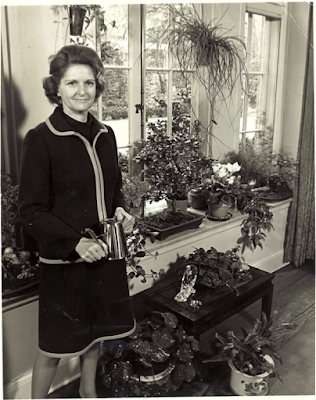 Ernesta Ballard
The leaders of the second-wave feminist movement, particularly those who were drawn to structured groups such as NOW, were for the most part skilled organization builders, who honed their skills in civic and professional associations, labor unions, and local Democratic Party committees. They were generally older, whiter, and more affluent than the younger women drawn to the Women’s Liberation movement. Although many had experience in grassroots organizations, some of these early leaders had served on the boards of elite organizations and had a network of elite connections. Chapter leaders had a great deal of latitude in deciding which of NOW’s many issues they wanted to foreground. Thus, the issues that particular chapters chose to address were very much bound up with the talents and interests of the leaders.—
The founders of Philadelphia NOW each put their personal stamp on the organization. The founder of Philadelphia NOW, Ernesta Drinker Ballard, born in 1920 into a prominent Philadelphia family, was clearly not the typical founder of a local NOW chapter. Her socialite background and life-long affiliation with the Republican Party notwithstanding, she was a passionate, committed feminist. Such intense commitment usually has some deeply personal source. Ballard told a Philadelphia Inquirer reporter in 1981 that she had wanted to be a lawyer, but that her father “never took it seriously.”1 Although she enjoyed significant class privileges, her options were constrained by the rigid gender roles of her time and class. Despite expectations that she confine herself to a life as wife and mother, Ballard managed to build a successful horticultural business and transform the Pennsylvania Horticultural Society into a world-class organization. When the feminist movement burst on the scene in the late 1960s, Ballard found her calling and dedicated her considerable talents in organization building to Philadelphia NOW.
The first president of Philadelphia NOW was not elected until 1970. Ballard clearly wanted to be part of the feminist movement but, whether as a consequence of her elite background or personal reticence (or both), she did not want to be the public face of the chapter and recruited Mary Lynne Speers as the chapter’s first president and Jean Ferson as its second. In a 2004 interview, Ballard described her role in forming Philadelphia NOW:
Ballard wrote to Friedan and said that her mother “would’ve been so thrilled to have been invited, but she can’t. She’s dead. If there’s anything I can do to help you, let me know.” Friedan called her to say: “I’m sorry about your mother. But will you do it? You’ll be fine. We’re looking for … Mainline, you know, establishment sort of a person.” Ballard readily accepted the invitation: “I was definitely a feminist, and I was thrilled to be asked.” However, she was concerned about a conflict with her position at the Pennsylvania Horticulture Society, and worried that feminism and horticulture didn’t “really mix very well.” She reported receiving critical letters, mostly from men, asking her “Why don’t you stick to your petunias?”2
Friedan was very interested in recruiting rich, well-connected women like Ballard, both for their access to financial resources and for what she saw as their ability to lend credibility to the fledgling organization. Although Friedan is often credited with launching a broad-based, grassroots movement, that was apparently not her original intention. Political scientist Jo Freeman has noted that some of NOW’s initiators like Friedan were “very high-powered women who lacked the time or patience for the slow, unglamorous work of putting together a mass organization.”3 Susan Brownmiller reported that Friedan rejected her application for membership because she did not fit the model of the successful professional woman Friedan was trying to recruit.4 However, Friedan’s original conception quickly evolved as women around the country expressed interest in forming local chapters.
Ernesta Ballard served for a year on the national NOW board and was the driving force behind the formation of the Philadelphia chapter. She reported: “Then, it came the time to really be formalized and say we have a structure and a president. And I said, ‘Look, I really can’t do it.’ It was going to interfere with my job and the media publicity … . It just wouldn’t work. So, I sort of stepped aside.” Although Mary Lynne Speers, a 28-year-old woman who aspired to go to law school, was Philadelphia NOW’s first president, Ballard was generally acknowledged to be the prime mover. According to Philadelphia NOW’s second president, Jean Ferson: “The woman who really started all this in Philadelphia was Ernesta Drinker Ballard.”5
Unlike her hero, suffragist Alice Paul, Ernesta Ballard was not accustomed to public demonstrations; it was not the way she and the people in her social networks got things done. However, when asked by Speers to participate in a 1970 vigil at the Capitol to bring the Equal Rights Amendment to the floor of Congress for a vote, she appears not to have hesitated. Ballard and Speers took the train to Washington and went to the Capitol:
Ballard recalled she knew the story would be in the newspapers when reporter Rose DeWolf called and said she heard that Ballard had spent the night in Washington.
The tone of Ballard’s 2004 recollection of the vigil contrasted sharply with her much less positive account reported by DeWolf the day after the event. During the 2004 interview Ballard recalled the event as an adventure and was clearly proud of the role she played. In the interview for DeWolf’s 1970 article, however, Ballard portrayed the vigil as a disappointment: “Do you know how many women were there, standing vigil? Four, that’s all. Why didn’t women come? There have been huge crowds when the issue was peace or civil rights. Don’t women care?” Mary Lynne Speers groped for an explanation: “Maybe women are just programmed to work for others, not themselves … . Or maybe they’re just tired of demonstrations…” Ballard raised questions about the wisdom of holding the event: “Maybe they were afraid to stay out at night. Maybe it was just our strategy that was wrong … maybe a 24-hour vigil just isn’t the way to make the point.”6 Another reason, no doubt, was that Philadelphia NOW’s founders did not have the resources to mobilize large numbers of people for demonstrations. Despite these setbacks, the founding members I interviewed clearly viewed the feminist movement as one of the peak experiences of their lives, and many, like Ballard, recalled the excitement and sense of solidarity much more vividly than the drudgery and disappointments
.
Participation in demonstrations and vigils may not have come naturally to Ernesta Ballard. What did come naturally was using her social contacts to put pressure on powerful interests to open opportunities for women. One of Philadelphia NOW’s first and most successful actions was challenging the sexist assumptions underlying a local job fair called Operation Native Son, sponsored by the Greater Philadelphia Chamber of Commerce. Once a year, the Chamber of Commerce provided an opportunity for Pennsylvanians attending college outside the state to be interviewed by prospective employers from the Philadelphia area. The program was blatantly discriminatory against women. According to Philadelphia NOW’s second president Jean Ferson:
When told that Jean Ferson had credited her with the victory, Ernesta Ballard downplayed her role: “Well, I was writing letters. Thatcher [Longstreth, the Chamber of Commerce president] was a friend of mine, so I said we have to do something about this.”
Philadelphia NOW won the battle, but it’s not clear who or what gets credit for the victory. NOW’ s letter writing campaign? The threat of legal action? Ernesta Ballard’s behind the scenes lobbying? No doubt, all of the above. And it is certainly possible that the Chamber of Commerce realized the times had changed and locking women out of job fairs was no longer an option. The files of founding member Judy Foley included, along with news clippings about NOW’s protests against Operation Native Son, Foley’s handwritten note: “Ernesta talked to Longstreth. He’s sympathetic—tried to get it changed before.” Perhaps Longstreth welcomed the pressure from NOW, which made it easier for him to change course. For Ernesta Ballard and the other founding members of Philadelphia NOW, their modus operandi for ending discriminatory practices included letter-writing campaigns to public officials and business leaders, threats of legal action, and using their personal connections for behind-the-scenes persuasion. They were not yet utilizing such tactics as mass rallies and never even considered civil disobedience. In this respect, they were very much in accord with the tactics of national NOW in its early years.
Ending discrimination in employment and enforcing “equal pay for equal work” were clearly national NOW’s top priorities in the late 1960s and early 1970s. According to Ernesta Ballard’s daughter Alice, her mother strongly disagreed with the national NOW board’s initial reluctance in the 1960s to champion abortion rights and lesbian rights, the two issues Alice Ballard recalled her mother was most passionate about.8 In response to pressure from members such as Ernesta Ballard, National NOW expanded its agenda and by 1971 was on record in support of both abortion rights and lesbian rights.
However, on both national and local levels, the activist energy in the late 1960s and early 1970s focused on ending discrimination in employment. NOW was determined to end the practice of dividing classified ads into “Help Wanted for Men” and “Help Wanted for Women.” While some feminists would organize demonstrations and others would initiate legal action, Ernesta Ballard protested directly to those in power. After all, as she said, many of these people were members of her social circle. According to Ballard:
Ballard knew where she had leverage and continued to pressure the local elite to end discriminatory practices and the ridicule of the feminist movement then filling the editorial pages.
The June 1973 Philadelphia NOW Newsletter recounts her outraged response to an appallingly sexist article, ‘Why Can’t a Woman Be like a Woman?” in the Delaware Valley Business Fortnight written by Myles Standish. (Yes, that really was his name, not a pseudonym, as I originally thought.) The fact that a respectable business journal thought it fit to publish this article speaks volumes about the climate of opinion in the early 1970s. From Standish’s article, quoted in full in the Philadelphia NOW Newsletter:
Standish associates the break down in rigid gender roles with homosexuality—a common theme in the early 1970s reaction against feminism. Also, quite typical was Standish’s sense that demands for gender equality were really a cover for a drive for dominance over men. He further argues that deviation from traditional gender “leads inevitably to the unhappiness of the female. And I have rarely seen more unhappy women at all age levels than in the United States.”10
Blaming feminism rather than sexism for the unhappiness of American women must have enraged Ernesta Ballard. The Philadelphia NOW Newsletter reprinted her letter to Thatcher Longstreth, president of the Philadelphia Chamber of Commerce:
The Philadelphia NOW Newsletter also printed Longstreth’s response. Despite a reference to the “garbage” coming from “Women’s Lib extremists,” his reply suggested that he was more advanced than most men from his background and generation. The newsletter’s record of the correspondence ends with the injunction: LETTER WRITERS, PICK UP YOUR PENS!11 Philadelphia NOW members at this point were not taking to the streets, but using all the insider tactics at their disposal to end discrimination against women.
Would Philadelphia NOW have been successful in getting the Chamber of Commerce to change its policies regarding Operation Native Son and its inclusion of blatantly sexist articles in its publications without Ernesta Ballard’s guiding hand and determination? My guess is it would not have happened so quickly. Ballard excelled in political persuasion and organization building—marshaling resources, securing funding, gaining the support of powerful opinion leaders—skills she had acquired though the volunteer work expected of women of her social class. Although Ernesta Ballard cultivated relationships with the local elite, her name does not appear in the documents pertaining to Philadelphia NOW’s members’ early forays into partisan politics. She does not appear to have been directly involved in the formation of the Philadelphia branch of the National Women’s Political Caucus in 1971. In the early 1970s, her public political involvement appears to have been largely confined to non-partisan civic organizations such as the League of Women Voters. Ballard’s lack of direct involvement in Philadelphia partisan politics on behalf of feminist issues in the early 1970s is no doubt in part due to her affiliation with the Republican Party. In the 1970s a political realignment was beginning to occur, and Republicans were becoming increasingly marginalized in city politics. Both nationally and locally the Democratic Party was becoming the political home of the feminist movement.
In my 2004 interview with Ballard, she bemoaned the change in her party. My guess is if she had lived, she would have left the party that had left her: “I stay Republican, partly out of stubbornness. Why should I quit … . There are a lot of moderate Republicans. We had a national organization about Republican Majority for Choice.” She wanted to go back to what she saw as the traditional Republican Party: “liberty, privacy, small government, national defense. You know they’re all good things. You couldn’t fault them.” Ballard saw no contradiction between equality for all women and the “small government” philosophy of the Republican Party. For her, feminism meant dismantling the legal barriers to women’s advancement in employment and education and safeguarding a woman’s reproductive rights; it did not include a commitment to a Scandinavian-style safety net.
As the feminist movement grew and became increasingly diverse, more feminists began to see a robust safety net funded by progressive taxation as essential for gender equality. Most of the women Ernesta Ballard worked with in the feminist movement were Democrats, advocates of government-funded social programs rather than the “small government” Ballard advocated; thus, maintaining distance from partisan politics was a way of avoiding conflict with her feminist allies. Ballard’s name appears in the membership lists of the National Women’s Political Caucus, a chapter of which was formed in Philadelphia in 1971, but the minutes do not indicate that she played a major role in the group. Her name generally does not appear in accounts of local public demonstrations—the 1970 vigil at the Capitol steps was a rare public protest for her.
Perhaps it was easier for her to engage in public protests when she was out of town. One of the few public feminist campaigns she was involved was the 1981 national NOW campaign to send feminist missionaries to Utah, the heart of the opposition to Equal Rights Amendment; they were to take the message of the ERA directly to the Mormon people, door to door. Ballard had just retired as executive director of the Philadelphia Horticultural Society and perhaps felt more comfortable engaging in overt political activity and activities such as door-to-door canvasing, but it was not something that came naturally to her.
During my 2004 interview with Ballard she recalled that she was canvasing in a “beautiful development.” When she rang a doorbell, the woman who opened the door asked, “Ernesta! What are you doing here?” Ballard remembered that the woman was on the board of the Garden Federation of the United States of America when Ballard was their horticulture chair. Ballard recalled: “She remembered me and said, ‘Come in. Come in.’ And she showed us her garden in the back, and I finally said, ‘I have to tell you why we’re here.” The woman replied: “I know why you’re here. I can see your buttons and everything. I can’t really do anything to help you, but give me your literature.” Ballard had not expected such a friendly reception and she was clearly moved by the woman’s response. Just as Ballard’s 2004 recollections of the 1970 Washington ERA vigil were more positive than her account reported the day after the event in the Philadelphia Bulletin, Ballard’s 2004 recollections of her involvement in the Missionaries to the Mormons campaign focused on positive memories in sharp contrast to the feelings she expressed to an Inquirer reporter at the time of campaign.
However, despite the hostile reaction from most of the Mormons, Ernesta Ballard did not regret participating in the campaign. During her stay she sent a postcard to the then president of Philadelphia NOW Doris Pechkurow: “I really feel like a martyr. It’s HOT, exhausting and we’re not popular! But the other missionaries are wonderful and the experience is one I wouldn’t have wanted to have missed.”12 Women from Ballard’s social world were not accustomed to the anger and rejection she experienced in Utah. In the final days of the campaign for the ERA, NOW had become more militant, more reliant on tactics like mass demonstrations and door-to-door canvassing, very different from the behind-the-scenes organizing that characterized Ballard’s participation in the early days of Philadelphia NOW. Ballard was a skilled organizer, but her tactics were usually the mainstream tactics she had learned in establishment philanthropic organizations. Her willingness to go beyond her comfort level and participate in the Missionaries to the Mormons campaign is surely an indication of the depth of her commitment to the passage of the ERA…
Philadelphia was a very segregated city in the 1960s and 1970s; unsurprisingly, the local NOW chapter reflected this. NOW chapters expanded through the social networks of the founders, and as they acknowledged, those networks were largely white and middle class. Although not expressed explicitly, the founders’ comments suggested that they just did not know how to develop ties with women from different racial backgrounds. Ballard told an Inquirer reporter that recognizing her own oppression as a woman enabled her to understand and overcome racial prejudice. Born in 1920, she grew up at a time when racial and religious prejudices were the norm. She recalled: “My grandmother used to say, ‘Always remember Ernesta, there are two really wicked things in life—whiskey and the Pope.’ And Blacks—when I grew up they were servants; they weren’t people. It took a while to get used to the idea that Jews and Blacks were people just like me, and I could love them. The moment of truth came when I began to realize that women too were discriminated against.”19 Very few women of Ballard’s generation and socio-economic background made this intellectual and emotional journey…
It was not just white affluent NOW members who had difficulty reaching across the racial divide. Feminist historian Alice Echols’ report on the first Women’s Liberation conference at Sandy Springs, Maryland in 1968 includes a transcript of a discussion on Black women and the Women’s Liberation movement. The transcript does not support the Women’s Liberation movement’s reputation for being the more radical strand of the movement and makes for uncomfortable reading from a 21st-century vantage point, revealing to what extent even the most progressive members of society lived in a segregated world, with little experience outside their racial group. From the transcript: “ok … I have problems dealing with Black people; I think everyone in this room does, with men or women. I think if we are really honest about it we don’t want to work with Black women because we are not sure what our relationship is.”20 Some members of the group did want to include Black women; most saw such outreach as problematic and were wary of doing so.
References both to racial discrimination and to the Vietnam War were generally absent from the NOW documents from the late 1960s and early 1970s. However, reflecting the growing influence of the anti-war movement on the feminist movement, in 1971 national NOW changed course and passed an anti-war resolution calling for an immediate end to all American military activity in Southeast Asia.23 National NOW has historically been ahead of local chapters in recognizing the connection of gender issues with other struggles for social justice. The 1971 resolution apparently did not have a major impact on Philadelphia NOW Philadelphia NOW in the early years was focused almost exclusively on women’s rights. The road to becoming an intersectional feminist organization would be a long and rocky one.
The leaders of the second-wave feminist movement, particularly those who were drawn to structured groups such as NOW, were for the most part skilled organization builders, who honed their skills in civic and professional associations, labor unions, and local Democratic Party committees. They were generally older, whiter, and more affluent than the younger women drawn to the Women’s Liberation movement. Although many had experience in grassroots organizations, some of these early leaders had served on the boards of elite organizations and had a network of elite connections. Chapter leaders had a great deal of latitude in deciding which of NOW’s many issues they wanted to foreground. Thus, the issues that particular chapters chose to address were very much bound up with the talents and interests of the leaders.—
The founders of Philadelphia NOW each put their personal stamp on the organization. The founder of Philadelphia NOW, Ernesta Drinker Ballard, born in 1920 into a prominent Philadelphia family, was clearly not the typical founder of a local NOW chapter. Her socialite background and life-long affiliation with the Republican Party notwithstanding, she was a passionate, committed feminist. Such intense commitment usually has some deeply personal source. Ballard told a Philadelphia Inquirer reporter in 1981 that she had wanted to be a lawyer, but that her father “never took it seriously.”1 Although she enjoyed significant class privileges, her options were constrained by the rigid gender roles of her time and class. Despite expectations that she confine herself to a life as wife and mother, Ballard managed to build a successful horticultural business and transform the Pennsylvania Horticultural Society into a world-class organization. When the feminist movement burst on the scene in the late 1960s, Ballard found her calling and dedicated her considerable talents in organization building to Philadelphia NOW.
The first president of Philadelphia NOW was not elected until 1970. Ballard clearly wanted to be part of the feminist movement but, whether as a consequence of her elite background or personal reticence (or both), she did not want to be the public face of the chapter and recruited Mary Lynne Speers as the chapter’s first president and Jean Ferson as its second. In a 2004 interview, Ballard described her role in forming Philadelphia NOW:
The way I got into it is kind of funny … . My mother was living with us and she was very ill; she was dying of cancer. She got a letter from Betty Friedan, and Betty’s letter said that she heard about my mother because my mother had written a book about music and women … and Betty said, ‘I’m forming this new organization called the National Organization for Women.’ And she wanted mother to go onto the board.
Ballard wrote to Friedan and said that her mother “would’ve been so thrilled to have been invited, but she can’t. She’s dead. If there’s anything I can do to help you, let me know.” Friedan called her to say: “I’m sorry about your mother. But will you do it? You’ll be fine. We’re looking for … Mainline, you know, establishment sort of a person.” Ballard readily accepted the invitation: “I was definitely a feminist, and I was thrilled to be asked.” However, she was concerned about a conflict with her position at the Pennsylvania Horticulture Society, and worried that feminism and horticulture didn’t “really mix very well.” She reported receiving critical letters, mostly from men, asking her “Why don’t you stick to your petunias?”2
Friedan was very interested in recruiting rich, well-connected women like Ballard, both for their access to financial resources and for what she saw as their ability to lend credibility to the fledgling organization. Although Friedan is often credited with launching a broad-based, grassroots movement, that was apparently not her original intention. Political scientist Jo Freeman has noted that some of NOW’s initiators like Friedan were “very high-powered women who lacked the time or patience for the slow, unglamorous work of putting together a mass organization.”3 Susan Brownmiller reported that Friedan rejected her application for membership because she did not fit the model of the successful professional woman Friedan was trying to recruit.4 However, Friedan’s original conception quickly evolved as women around the country expressed interest in forming local chapters.
Ernesta Ballard served for a year on the national NOW board and was the driving force behind the formation of the Philadelphia chapter. She reported: “Then, it came the time to really be formalized and say we have a structure and a president. And I said, ‘Look, I really can’t do it.’ It was going to interfere with my job and the media publicity … . It just wouldn’t work. So, I sort of stepped aside.” Although Mary Lynne Speers, a 28-year-old woman who aspired to go to law school, was Philadelphia NOW’s first president, Ballard was generally acknowledged to be the prime mover. According to Philadelphia NOW’s second president, Jean Ferson: “The woman who really started all this in Philadelphia was Ernesta Drinker Ballard.”5
Unlike her hero, suffragist Alice Paul, Ernesta Ballard was not accustomed to public demonstrations; it was not the way she and the people in her social networks got things done. However, when asked by Speers to participate in a 1970 vigil at the Capitol to bring the Equal Rights Amendment to the floor of Congress for a vote, she appears not to have hesitated. Ballard and Speers took the train to Washington and went to the Capitol:
And we were relieved that there were people on the steps. There weren’t that many. Three of us and maybe four or five others. Not many people paid attention to us, but we stayed there the whole night. And that was a little adventure. At about 6 or 7 o’clock some people came to relieve us. And we went to the station, got on the train, and went home.
Ballard recalled she knew the story would be in the newspapers when reporter Rose DeWolf called and said she heard that Ballard had spent the night in Washington.
The tone of Ballard’s 2004 recollection of the vigil contrasted sharply with her much less positive account reported by DeWolf the day after the event. During the 2004 interview Ballard recalled the event as an adventure and was clearly proud of the role she played. In the interview for DeWolf’s 1970 article, however, Ballard portrayed the vigil as a disappointment: “Do you know how many women were there, standing vigil? Four, that’s all. Why didn’t women come? There have been huge crowds when the issue was peace or civil rights. Don’t women care?” Mary Lynne Speers groped for an explanation: “Maybe women are just programmed to work for others, not themselves … . Or maybe they’re just tired of demonstrations…” Ballard raised questions about the wisdom of holding the event: “Maybe they were afraid to stay out at night. Maybe it was just our strategy that was wrong … maybe a 24-hour vigil just isn’t the way to make the point.”6 Another reason, no doubt, was that Philadelphia NOW’s founders did not have the resources to mobilize large numbers of people for demonstrations. Despite these setbacks, the founding members I interviewed clearly viewed the feminist movement as one of the peak experiences of their lives, and many, like Ballard, recalled the excitement and sense of solidarity much more vividly than the drudgery and disappointments
.
Participation in demonstrations and vigils may not have come naturally to Ernesta Ballard. What did come naturally was using her social contacts to put pressure on powerful interests to open opportunities for women. One of Philadelphia NOW’s first and most successful actions was challenging the sexist assumptions underlying a local job fair called Operation Native Son, sponsored by the Greater Philadelphia Chamber of Commerce. Once a year, the Chamber of Commerce provided an opportunity for Pennsylvanians attending college outside the state to be interviewed by prospective employers from the Philadelphia area. The program was blatantly discriminatory against women. According to Philadelphia NOW’s second president Jean Ferson:
Operation Native Son was something that drove Ernesta nuts … . [She said,] ‘We need to change that name.’ And we did … we got the name changed. And there was a tremendous concern around that time in terms of how language was used to discriminate against women or to insult women, and we wanted people to get more aware of that.
When told that Jean Ferson had credited her with the victory, Ernesta Ballard downplayed her role: “Well, I was writing letters. Thatcher [Longstreth, the Chamber of Commerce president] was a friend of mine, so I said we have to do something about this.”
Philadelphia NOW won the battle, but it’s not clear who or what gets credit for the victory. NOW’ s letter writing campaign? The threat of legal action? Ernesta Ballard’s behind the scenes lobbying? No doubt, all of the above. And it is certainly possible that the Chamber of Commerce realized the times had changed and locking women out of job fairs was no longer an option. The files of founding member Judy Foley included, along with news clippings about NOW’s protests against Operation Native Son, Foley’s handwritten note: “Ernesta talked to Longstreth. He’s sympathetic—tried to get it changed before.” Perhaps Longstreth welcomed the pressure from NOW, which made it easier for him to change course. For Ernesta Ballard and the other founding members of Philadelphia NOW, their modus operandi for ending discriminatory practices included letter-writing campaigns to public officials and business leaders, threats of legal action, and using their personal connections for behind-the-scenes persuasion. They were not yet utilizing such tactics as mass rallies and never even considered civil disobedience. In this respect, they were very much in accord with the tactics of national NOW in its early years.
Ending discrimination in employment and enforcing “equal pay for equal work” were clearly national NOW’s top priorities in the late 1960s and early 1970s. According to Ernesta Ballard’s daughter Alice, her mother strongly disagreed with the national NOW board’s initial reluctance in the 1960s to champion abortion rights and lesbian rights, the two issues Alice Ballard recalled her mother was most passionate about.8 In response to pressure from members such as Ernesta Ballard, National NOW expanded its agenda and by 1971 was on record in support of both abortion rights and lesbian rights.
However, on both national and local levels, the activist energy in the late 1960s and early 1970s focused on ending discrimination in employment. NOW was determined to end the practice of dividing classified ads into “Help Wanted for Men” and “Help Wanted for Women.” While some feminists would organize demonstrations and others would initiate legal action, Ernesta Ballard protested directly to those in power. After all, as she said, many of these people were members of her social circle. According to Ballard:
The editor of the Philadelphia Bulletin, Bobby Taylor, was a friend of mine. I wrote a letter to him and said, ‘You know, this is terrible!’ He said they felt that what they were doing was right and fair and appropriate. He didn’t need any advice. It was a snooty, snooty letter. But it gradually did begin to change.
Ballard knew where she had leverage and continued to pressure the local elite to end discriminatory practices and the ridicule of the feminist movement then filling the editorial pages.
The June 1973 Philadelphia NOW Newsletter recounts her outraged response to an appallingly sexist article, ‘Why Can’t a Woman Be like a Woman?” in the Delaware Valley Business Fortnight written by Myles Standish. (Yes, that really was his name, not a pseudonym, as I originally thought.) The fact that a respectable business journal thought it fit to publish this article speaks volumes about the climate of opinion in the early 1970s. From Standish’s article, quoted in full in the Philadelphia NOW Newsletter:
It is difficult for me to see the masculine allure in an alleged male, wearing feminine, hip-hugging trousers over platform shoes made of a Joseph’s coat collection of colored leathers! Seemingly, the gay boys who got their revenge on the gals by making them look totally ridiculous in the clothes the gays designed for them, are trying to wreak the same sort of revenge on the men…9
Standish associates the break down in rigid gender roles with homosexuality—a common theme in the early 1970s reaction against feminism. Also, quite typical was Standish’s sense that demands for gender equality were really a cover for a drive for dominance over men. He further argues that deviation from traditional gender “leads inevitably to the unhappiness of the female. And I have rarely seen more unhappy women at all age levels than in the United States.”10
Blaming feminism rather than sexism for the unhappiness of American women must have enraged Ernesta Ballard. The Philadelphia NOW Newsletter reprinted her letter to Thatcher Longstreth, president of the Philadelphia Chamber of Commerce:
As an old friend, and one has been fair to women, I am asking you to read the editorial in the Business Fortnight and ask yourself: Does it go out of its way to belittle women? Does it go out of its way to insult homosexuals? Does it belong in Business Fortnight? Does it represent the view of the Chamber of Commerce?
The Philadelphia NOW Newsletter also printed Longstreth’s response. Despite a reference to the “garbage” coming from “Women’s Lib extremists,” his reply suggested that he was more advanced than most men from his background and generation. The newsletter’s record of the correspondence ends with the injunction: LETTER WRITERS, PICK UP YOUR PENS!11 Philadelphia NOW members at this point were not taking to the streets, but using all the insider tactics at their disposal to end discrimination against women.
Would Philadelphia NOW have been successful in getting the Chamber of Commerce to change its policies regarding Operation Native Son and its inclusion of blatantly sexist articles in its publications without Ernesta Ballard’s guiding hand and determination? My guess is it would not have happened so quickly. Ballard excelled in political persuasion and organization building—marshaling resources, securing funding, gaining the support of powerful opinion leaders—skills she had acquired though the volunteer work expected of women of her social class. Although Ernesta Ballard cultivated relationships with the local elite, her name does not appear in the documents pertaining to Philadelphia NOW’s members’ early forays into partisan politics. She does not appear to have been directly involved in the formation of the Philadelphia branch of the National Women’s Political Caucus in 1971. In the early 1970s, her public political involvement appears to have been largely confined to non-partisan civic organizations such as the League of Women Voters. Ballard’s lack of direct involvement in Philadelphia partisan politics on behalf of feminist issues in the early 1970s is no doubt in part due to her affiliation with the Republican Party. In the 1970s a political realignment was beginning to occur, and Republicans were becoming increasingly marginalized in city politics. Both nationally and locally the Democratic Party was becoming the political home of the feminist movement.
In my 2004 interview with Ballard, she bemoaned the change in her party. My guess is if she had lived, she would have left the party that had left her: “I stay Republican, partly out of stubbornness. Why should I quit … . There are a lot of moderate Republicans. We had a national organization about Republican Majority for Choice.” She wanted to go back to what she saw as the traditional Republican Party: “liberty, privacy, small government, national defense. You know they’re all good things. You couldn’t fault them.” Ballard saw no contradiction between equality for all women and the “small government” philosophy of the Republican Party. For her, feminism meant dismantling the legal barriers to women’s advancement in employment and education and safeguarding a woman’s reproductive rights; it did not include a commitment to a Scandinavian-style safety net.
As the feminist movement grew and became increasingly diverse, more feminists began to see a robust safety net funded by progressive taxation as essential for gender equality. Most of the women Ernesta Ballard worked with in the feminist movement were Democrats, advocates of government-funded social programs rather than the “small government” Ballard advocated; thus, maintaining distance from partisan politics was a way of avoiding conflict with her feminist allies. Ballard’s name appears in the membership lists of the National Women’s Political Caucus, a chapter of which was formed in Philadelphia in 1971, but the minutes do not indicate that she played a major role in the group. Her name generally does not appear in accounts of local public demonstrations—the 1970 vigil at the Capitol steps was a rare public protest for her.
Perhaps it was easier for her to engage in public protests when she was out of town. One of the few public feminist campaigns she was involved was the 1981 national NOW campaign to send feminist missionaries to Utah, the heart of the opposition to Equal Rights Amendment; they were to take the message of the ERA directly to the Mormon people, door to door. Ballard had just retired as executive director of the Philadelphia Horticultural Society and perhaps felt more comfortable engaging in overt political activity and activities such as door-to-door canvasing, but it was not something that came naturally to her.
During my 2004 interview with Ballard she recalled that she was canvasing in a “beautiful development.” When she rang a doorbell, the woman who opened the door asked, “Ernesta! What are you doing here?” Ballard remembered that the woman was on the board of the Garden Federation of the United States of America when Ballard was their horticulture chair. Ballard recalled: “She remembered me and said, ‘Come in. Come in.’ And she showed us her garden in the back, and I finally said, ‘I have to tell you why we’re here.” The woman replied: “I know why you’re here. I can see your buttons and everything. I can’t really do anything to help you, but give me your literature.” Ballard had not expected such a friendly reception and she was clearly moved by the woman’s response. Just as Ballard’s 2004 recollections of the 1970 Washington ERA vigil were more positive than her account reported the day after the event in the Philadelphia Bulletin, Ballard’s 2004 recollections of her involvement in the Missionaries to the Mormons campaign focused on positive memories in sharp contrast to the feelings she expressed to an Inquirer reporter at the time of campaign.
However, despite the hostile reaction from most of the Mormons, Ernesta Ballard did not regret participating in the campaign. During her stay she sent a postcard to the then president of Philadelphia NOW Doris Pechkurow: “I really feel like a martyr. It’s HOT, exhausting and we’re not popular! But the other missionaries are wonderful and the experience is one I wouldn’t have wanted to have missed.”12 Women from Ballard’s social world were not accustomed to the anger and rejection she experienced in Utah. In the final days of the campaign for the ERA, NOW had become more militant, more reliant on tactics like mass demonstrations and door-to-door canvassing, very different from the behind-the-scenes organizing that characterized Ballard’s participation in the early days of Philadelphia NOW. Ballard was a skilled organizer, but her tactics were usually the mainstream tactics she had learned in establishment philanthropic organizations. Her willingness to go beyond her comfort level and participate in the Missionaries to the Mormons campaign is surely an indication of the depth of her commitment to the passage of the ERA…
Philadelphia was a very segregated city in the 1960s and 1970s; unsurprisingly, the local NOW chapter reflected this. NOW chapters expanded through the social networks of the founders, and as they acknowledged, those networks were largely white and middle class. Although not expressed explicitly, the founders’ comments suggested that they just did not know how to develop ties with women from different racial backgrounds. Ballard told an Inquirer reporter that recognizing her own oppression as a woman enabled her to understand and overcome racial prejudice. Born in 1920, she grew up at a time when racial and religious prejudices were the norm. She recalled: “My grandmother used to say, ‘Always remember Ernesta, there are two really wicked things in life—whiskey and the Pope.’ And Blacks—when I grew up they were servants; they weren’t people. It took a while to get used to the idea that Jews and Blacks were people just like me, and I could love them. The moment of truth came when I began to realize that women too were discriminated against.”19 Very few women of Ballard’s generation and socio-economic background made this intellectual and emotional journey…
It was not just white affluent NOW members who had difficulty reaching across the racial divide. Feminist historian Alice Echols’ report on the first Women’s Liberation conference at Sandy Springs, Maryland in 1968 includes a transcript of a discussion on Black women and the Women’s Liberation movement. The transcript does not support the Women’s Liberation movement’s reputation for being the more radical strand of the movement and makes for uncomfortable reading from a 21st-century vantage point, revealing to what extent even the most progressive members of society lived in a segregated world, with little experience outside their racial group. From the transcript: “ok … I have problems dealing with Black people; I think everyone in this room does, with men or women. I think if we are really honest about it we don’t want to work with Black women because we are not sure what our relationship is.”20 Some members of the group did want to include Black women; most saw such outreach as problematic and were wary of doing so.
References both to racial discrimination and to the Vietnam War were generally absent from the NOW documents from the late 1960s and early 1970s. However, reflecting the growing influence of the anti-war movement on the feminist movement, in 1971 national NOW changed course and passed an anti-war resolution calling for an immediate end to all American military activity in Southeast Asia.23 National NOW has historically been ahead of local chapters in recognizing the connection of gender issues with other struggles for social justice. The 1971 resolution apparently did not have a major impact on Philadelphia NOW Philadelphia NOW in the early years was focused almost exclusively on women’s rights. The road to becoming an intersectional feminist organization would be a long and rocky one.
Saturday, March 12, 2022
Feminist Organizing Across the Generations: Introduction
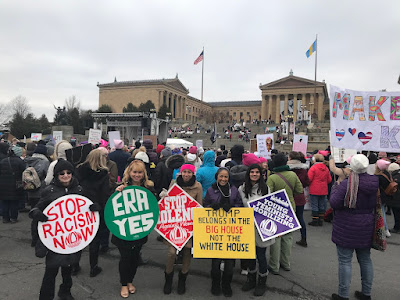
Introduction
Part: The Roots and Growth of the Second Wave Feminist Battle Against Gender Discrimination
Feminist Organizing Across the Generations traces the evolution of a social movement over time and argues that strong internal structure is necessary for the success of such movements. Part I, “Building the Feminist Movement,” analyzes the challenge to gender discrimination embedded in all major social institutions, a story unfolding in similar ways across the country, and focuses on a case study, the history of the Philadelphia chapter of the National Organization for Women (NOW). Although this study covers a time period extending from 1966 to 2021 and explores a range of philosophies and organizational models, it largely centers on one city, connecting what took place in Philadelphia with what was occurring nationally.
In most major cities in the late 1960s, the local NOW chapter was the major engine of institutional change. Like most NOW chapters, the history of Philadelphia NOW is very much intertwined with that of NOW’s national and state organizations and its history thus has a larger dimension. On the national level NOW has been well documented; however, many of the local stories have yet to be told. This study examines both the national and local levels of NOW in the context of a powerful social movement, and analyzes NOW’s relationships with other mainstream feminist organizations, such as the National Women’s Political Caucus and its local affiliate, and with what was considered the more radical Women’s Liberation movement
.
Although NOW may have been the focal point, it was certainly not the only locus of feminist activity in the late 1960s and 1970s. NOW activists were primarily focused on changing the rules governing society and opening up opportunities in government, business, and traditionally male occupations to women. Some, like Philadelphia NOW founding member and psychologist Jean Ferson, were also involved in the consciousness-raising movement, the feminist therapy movement, and the emerging women’s health movement. Other feminists focused on creating feminist free spaces—book stores, clubs, music festivals—rather than building feminist organizations. Some feminists did not belong to explicitly feminist organizations like NOW but worked tirelessly for gender justice in their unions, professional associations, educational institutions, and religious organizations. Some wanted nothing less than total revolution and were impatient with and often contemptuous of those trying to reform existing social institutions. The energy and creativity were astonishing. The changes in the status of women in the past half-century have been enormous and have become so much a part of the air we breathe that we no longer perceive the extent of the change.
The feminist movement, which emerged in the mid-1960s, may in retrospect appear inevitable, but this was not the case at the time. It was a revolution that virtually no one saw coming. Ruth Rosen begins her history of second-wave feminism with a 1967 quote from Harvard sociologist David Riesman: “If anything remains more or less unchanged, it will be the role of women.”1 Even many of the second-wave pioneers of the early and mid-1960s did not expect dramatic changes in gender roles. Civil rights workers Casey Hayden and Mary King’s influential 1965 memo, “Sex and Caste,” based on their experiences in the Student Non-Violent Coordinating Committee (SNCC), concluded on a pessimistic note: “Objectively the chances seem nil that we could start a movement based on anything as distant to general American thought as a sex-caste system.”2 When political scientist Jo Freeman in 1966 applied to the Institute of Policy Studies to learn about political organizing, she told the directors she wanted to organize women. The response: “There’s no future in that.”3
Although initially the second-wave feminist movement seemed to come out of nowhere, many of the leaders had considerable experience in building and maintaining organizations. The feminist movement that took so many by surprise is well documented on the national level and a rough consensus has emerged on the main contours of the national movement. Most historians of second-wave feminism define it in terms of two strands often characterized as the earlier, liberal reformist strand associated with hierarchical, structured organizations like NOW, and the somewhat later, generally considered more radical, “women’s liberation” strand consisting of small, loosely organized non-hierarchical collectives.
The first strand emerged in the 1960s, assisted by the networks formed by the Kennedy Commission on the Status of Women. Impatience with the slow pace of change, in particular the failure of the Equal Employment Opportunity Commission (EEOC) to take sex discrimination seriously, led to the formation of NOW in 1966, with the charismatic leader Betty Friedan as its first president. Friedan did not initially envision NOW as a mass movement.4 However, her original conception quickly evolved as women around the country expressed interest in forming local chapters.
Friedan’s The Feminine Mystique, published in 1963, resonated with millions of American women. In her study of the response to Friedan’s book, sociologist Stephanie Coontz documents a world of institutionalized gender discrimination persisting well into the early 1970s. Among the more egregious examples cited by Coontz: in 1965 only four states allowed a married woman the right to a legal residence separate from her husband’s. When a woman lived apart from her husband, she was usually unable to buy or rent a home on her own. Coontz reported that as late as 1972, a woman “could not rent an apartment until her husband, a patient in a mental hospital, signed the lease.”5 Sometimes discrimination was a matter of custom; sometimes it was a matter of statute. There was considerable variation from state to state, certainly contributing to the support for an Equal Rights Amendment which would wipe out all such statutes in one fell swoop.
Conditions were ripe for major change. Increasing numbers of women were in the labor force, had access to higher education, and were less likely to acquiesce to discriminatory practices. Only a relatively small number joined NOW, but many more were rethinking choices in their individual lives. Also, the civil rights movement had a profound impact on the entire society. The connection between the nascent feminist movement and the civil rights movement has usually been made with reference to the young women radicalized by their experiences in the civil rights movement. But the influence extended far beyond those few actively involved. Of course, not every woman beginning to challenge gender hierarchy likened the struggle against sexism to the civil rights movement, but the pervasive sense that all established institutions were being challenged and that a new world was in the making surely had an impact.
The Women’s Liberation strand of the feminist movement emerged in part from the women involved in the civil rights movement and in part from a somewhat younger cohort involved in the anti-war movement and the New Left organizations of the late 1960s. Although the women drawn to NOW were generally somewhat older than the women drawn to the Women’s Liberation movement, there were some notable exceptions. Gloria Steinem, for example, reports that though closer in age to the women in NOW, she was “drawn to the more radical and younger ones.”6 Although an over-simplification, the two strands have also been seen as structured vs. structureless organizations. The diffuse Women’s Liberation movement, which largely disappeared from the scene by the late 1970s, may have had a more radical vision than what was viewed as the liberal strand of the movement associated with NOW, but its impact on institutions was far less apparent and more difficult to measure.
The impact of liberal feminism associated with NOW is certainly easier to gauge. With a structure that enabled it to operate effectively on all three levels of government, NOW had a string of major legislative victories that transformed our society. Many NOW members saw themselves as the real radicals, using mainstream tactics to achieve radical ends. At a time when the term “liberal” is associated in the minds of many with the far left, and polling organizations frequently list “liberal” as the leftmost choice when asking for political allegiance, it may come as a surprise that in the late sixties “liberal” was often used contemptuously to describe a timid upholder of the status quo. In the 1970s historians tended to describe feminism in terms of three strands—liberal, radical, and socialist feminism. However, a movement as large and diverse as the feminist movement could never be reduced to a tidy, clear-cut taxonomy; these are contested terms, with evolving meanings. By the 1980s, references to socialist feminism tended to disappear, at least among American feminists, and the difference between liberal and radical feminism became increasingly difficult to disentangle.
The prevailing narrative, which sees liberal feminism supplanted by a more vibrant radical feminism associated with the Women’s Liberation’s movement, has not gone unchallenged. In 1975 political scientist Jo Freeman argued: “Some groups called ‘reformist’ have a platform that would so completely change our society it would be unrecognizable.”7 Sociologist Barbara Ryan noted that interviews she conducted in the late 1980s “show that feminists from a wide range of groups consider their goals to be radical—not because they were getting arrested by the hundreds, but because they believe they are attempting to achieve social relations that are radically different than what we have known in the past.”8 More recently, historian Stephanie Gilmore has also challenged the sharp distinctions between liberal and radical feminism.9
Histories drawing upon the documents of the time often perpetuate the conception of the “liberal” National Organization for Women (NOW) as the right wing of the women’s movement. National histories have tended to emphasize the widely publicized actions of the radical Women’s Liberation strand associated with groups like New York’s Redstockings, and often give the impression that this strand involved large numbers and was numerically a force equal to what was sometimes disparagingly referred to as the “liberal” reform strand associated with NOW. NOW kept membership records; the decentralized Women’s Liberation movement for the most part did not, making comparisons quite difficult. There was no hard and clear division between these two strands, and during the 1970s, NOW was influenced by the values and tactics of the Women’s Liberation movement. Towards the end of the 1970s, the Women’s Liberation movement faded from the scene. However, some of the feminist service organizations that grew out of small Women’s Liberation collectives endured for decades. Also, many of the values and approaches to organizing associated with Women’s Liberation were to resurface in the 21st century. By the end of the 1970s, the two strands of the women’s movement, radical and liberal, essentially merged within NOW, in some places the only feminist organization left standing.
The “second wave” feminist movement, which emerged in the United States in the late 1960s, was far more diverse, both ethnically and regionally, than is generally acknowledged. The term “second wave,” intended to distinguish the feminist movement of the 1960s and 1970s from the first wave, the 19th-century suffrage movement, has been challenged by feminist scholars who view the wave metaphor as a simplistic schema that ignores the continuities between “waves” and fails to acknowledge feminist activism between waves.10 Furthermore, according to historian Kimberly Springer, the wave metaphor has followed the trajectory of white women’s feminism and de-emphasized the feminist activism of women of color, an activist tradition not fitting so neatly into the wave schema.11 This of course is the historian’s dilemma: while some periodization is necessary to describe broad historical trends, the categories are always imprecise, the boundary lines fluid.
Some feminist theorists have tried to continue the wave metaphor, applying it to a “third wave” used to describe some strands of 1990s feminism emphasizing diversity and intersectionality. Although the term “second wave” has some utility as it is generally clear what it signifies, this is not the case with the term “third wave.” Used sometimes as a generational marker to describe feminists coming of age in the 1990s and at other times to describe a feminist philosophy grounded in intersectionality, the “third wave” was for the most part a cultural phenomenon, living largely online. No strong organizations capable of mounting a serious challenge to social institutions emerged from third-wave feminism. The term “fourth wave” is occasionally used to describe 21st-century feminism, but its meaning is even less well defined than that of “third wave” feminism, with the wave metaphor used less frequently by feminist theorists and historians.
One of the best analyses of the wave metaphor, which captures both its weakness and its usefulness, is that developed Leila J. Rupp and Verta Taylor:
The wave metaphor … may have more utility than we thought, as long as we understand that the lulls between the waves are still moving, that, from a transnational perspective, there may be choppy seas rather than even swells, and that waves do not rise and crash independently of each other.12
More recently, Annelise Orleck has challenged the wave theory, arguing that “the movement has been ceaseless. There have been bigger and smaller waves. But, as in the ocean, the waves have kept on coming.”13 Orleck cautions against underestimating advances made during what she calls “the trough years” of the 1920s, 1930s, and 1940s when trade union feminists waged battles for pay equity and better working conditions, paving the way for the major changes in women’s status associated with second-wave feminism.14
Whatever we ultimately call the explosion of feminist activism which occurred from the late 1960s through the late 1970s, momentous changes in gender roles were happening, albeit unevenly, all over America. Most of the published material documenting the second-wave feminist movement focuses on a few major urban centers—New York City, Boston, Chicago, San Francisco, and Los Angeles.15 These national narratives tend to be based on the same sources and often rely on the same anecdotes. Historians of the feminist movement have begun to complicate the story of second-wave feminism, which has often been viewed as largely white, middle class, and centered in a few major urban areas. More recent studies have focused on the role of working-class women and women of color16 and also on geographical locations outside the epicenters of second-wave feminism.17
Many feminists’ conception of the movement has expanded to include grassroots women who did not identify as feminists but whose activism is clearly part of the feminist project.18 Also, there were many feminist initiatives (e.g., feminist bookstores, coffee shops, music festivals, lesbian bars) organized by small groups of women independent of any feminist organization and usually not included in the grand narratives of second-wave feminism.19 Recently, much original research (rather than analysis and critique of existing narratives) has been found in regional and local histories. Scholars are just beginning to document the regional diversity of what Rosalyn Baxandall and Linda Gordon have called “the largest social movement in the history of the U.S.”20 These local histories will at some point be woven into a richer, more nuanced tapestry of “second wave” feminism.
Social movement historians usually consider NOW the major social movement organization of “second wave” feminism. Although many other feminist organizations were active in the 1970s, there were none with the influence and staying power of NOW. Toni Carabillo in the Feminist Chronicles, 1953–1993 saw the National Organization for Women (NOW)
justifiably as the organizing focal point of the movement … . Though Women’s Liberation groups emerged and flourished across the country for a few passionate years, they lacked national coordination, goals, an accepted leadership, and, not the least, an effective fundraising mechanism. Other organizations nurtured the movement … . But NOW has remained central to its existence and vitality.21
What accounts for the staying power of NOW? Why was NOW in many places the only multi-issue feminist organization remaining in the early 1980s? As I delved into the archival material, I was struck by the degree to which the founding members of NOW thought deeply about structure. NOW’s emphasis on building a federated structure operating on all levels of government enabled the organization to function effectively in the political arena and was certainly a major factor in the legislative victories of the 1970s, as well as in its long-term survival. NOW shared credit with many other feminist organizations (as well as a loose network of feminist bookstores, coffee houses, and consciousness-raising groups) for the dramatic changes in hearts and minds, but NOW was the main engine behind victories in state and national legislatures and in the courts.
Unlike the loosely organized, evanescent Women’s Liberation groups, which formed in the early 1970s, local NOW chapters were to varying degrees connected to both the national and state organizations. The national organization owed much of its political clout to its local networks of grassroots activists, and local chapters benefitted from the resources of the national organization. This was especially the case with Philadelphia NOW because of its geographical proximity to the national NOW office and the personal relationships between Philadelphia activists and national and state leaders.
The founding members of Pennsylvania NOW—in particular, Eleanor Smeal and Beverly Jones—paid very close attention to structural issues, with Jones writing an influential rationale for creating a highly structured organization with both state and local affiliates.22 (See chapter 2.) Philadelphia NOW maintained a close relationship with Smeal during her presidency of Pennsylvania NOW and later of national NOW, and was clearly influenced by her attention to structural issues. The history of Philadelphia NOW illustrates how the interrelationships between local, state, and national levels of NOW worked in practice when there was trust and cooperation among the leadership on all three levels of the organization.
The basic unit of NOW, the local chapter, turned out to be very useful in accommodating the variation in the style and priorities of NOW members. The initial impulse for the founding of NOW chapters varied from region to region, although certain issues such as the ERA were priorities for virtually all chapters; however, as long as chapters were not acting in contradiction to NOW’s positions, they were free to choose their priorities from among the many issues NOW addressed. For example, Stephanie Gilmore documents how West Coast NOW chapters took up the cause of prostitutes’ rights, an issue not on the agenda for NOW activists in Philadelphia.23 In the pre-internet age most feminists identified primarily with their local organization; this was certainly the case with local NOW chapters. Only those who had friends and colleagues among the national leadership or aspired to it themselves closely followed the affairs of national NOW. Thanks to the internet, both the achievements of national organizations and the conflicts among feminists on the national level are now widely known and amplified by social media. Twenty-first-century feminists frequently see themselves as part of a national or international movement and can easily keep up with the struggles of feminists around the globe.
There was little evidence of such international awareness among Philadelphia NOW’s founding members in the 1960s. The initial direction of the Philadelphia NOW chapter was influenced by the skills and interests of its founding mothers Ernesta Ballard, Jean Ferson, and Jan Welch. (See chapter 1.) Ballard in particular brought her considerable experience in non-profit organizations to the task of founding Philadelphia NOW. These founding members focused primarily on expanding career opportunities for women, consistent with the focus of National NOW in the late 1960s. As the movement grew, it included more and more women who were not political activists and who were primarily interested in how traditional gender roles affected their personal lives. Philadelphia NOW’s second president, Jean Ferson, a psychologist, shared that interest and, unlike some NOW activists, was receptive to the growing consciousness-raising movement. Ferson’s embrace of consciousness-raising contributed significantly to the growth of the chapter.
Political and Racial Tensions Within NOW
In addition to accommodating the diverse priorities of NOW members around the country, the chapter model also served as a safety valve for defusing political and personal conflicts and as a vehicle for surviving the increasingly bitter divisions which threatened to tear apart national NOW and also endangered some local chapters. In the mid-to late 1970s, the Socialist Workers’ Party (SWP) attempted to infiltrate NOW on the national and local levels. (See chapter 2.) The situation in Philadelphia was complicated by personal tensions; it appears that one faction may have been using the SWP presence as an excuse to split the chapter. As national NOW allowed the formation of a new chapter with only ten dues-paying members, the ease with which a dissident group could simply form a new chapter defused tension while keeping everyone under the big tent of NOW.
The chapter model also functioned as a vehicle for defusing racial conflicts. (See chapter 3.) National and Pennsylvania NOW newsletters in the late 1970s and early1980s reflect a growing emphasis on issues of race and class. As a result of Pennsylvania NOW’s commitment to eliminating racism, a new chapter, Germantown NOW, was formed in Philadelphia to fight for racial and gender justice. The core Philadelphia chapter remained focused on passage of the Equal Rights Amendment; Philadelphia NOW members who were interested in addressing racial justice issues joined Germantown NOW. These breakaway chapters raise questions about the wisdom of allowing small groups with priorities different from the core chapter’s to go their own way. Such chapters could be viewed as strengthening the organization by enabling members to focus on their priorities while keeping everyone within the big tent of NOW. They could also be viewed as a way of avoiding difficult conversations the organization needed to have.
Unfortunately, there is more than a grain of truth in the widely held view that NOW was primarily a white women’s organization. National NOW tried very hard to counter this perception, and because national leaders had contacts with women involved in the civil rights and labor movements, they had some success in recruiting women of color for national leadership positions. This was much more of a challenge for local chapters. Philadelphia, for example, was a segregated city in the 1960s and 1970s; it is not surprising that the local NOW chapters reflected this. NOW chapters expanded through the social networks of the founders, and as they acknowledged, those networks were largely white and middle class.
In the 1970s, women of color were organizing to improve women’s lives, but generally not under an explicitly feminist banner. Many were involved in civil rights organizations and in the movement for Black political empowerment; others were involved in grassroots neighborhood organizations. The African-American community activists from Philadelphia described in Nancy Naples’ Grassroots Warriors: Activist Mothering, Community Work and the War on Poverty did not generally identify as feminists and their activism has usually not been considered part of the feminist project.24
Susan Hartmann, in The Other Feminists: Activists in the Liberal Establishment, documents the work of African-American feminists who “found the ACLU, the NCC [National Council of Churches], and the Ford Foundation more convenient or more congenial places than mainstream feminist groups to pursue feminist aspirations.”25 Once these women’s experiences are fully integrated into the history of second-wave feminism, a far richer narrative will emerge. The feminist movement is much broader than those organizations with an explicitly feminist agenda.
From the very beginning, NOW was a political player, engaged in lobbying and letter-writing campaigns to legislators; however, in the early years, many NOW members were deeply suspicious of direct involvement in electoral politics. In the early and mid-1970s, Philadelphia NOW dealt with this distrust by farming out electoral politics to the Philadelphia Women’s Political Caucus (PWPC), formed in 1971. Philadelphia NOW members were instrumental in the formation of PWPC but wanted to keep NOW itself unsullied by the messy compromises of partisan politics. Distrust of electoral politics was not confined to NOW members but was pervasive among progressive movements in the late 1960s and 1970s.
NOW’s attitudes towards participation in electoral politics evolved as the decade wore on; the battle for passage of the Equal Rights Amendment and the struggle to protect abortion rights underscored the need for electing feminist legislators. (See chapter 4.) With the election of Ronald Reagan in 1980 the tide had turned in favor of the right; the final years of the struggle for ERA ratification were fought in the shadow of the Reagan victory. The ERA campaign itself became a training ground in the basics of the political process and many NOW members considered running for office. NOW had built a structure capable of effectively channeling the energy of its members and facilitating their entrance into the political arena as candidates, campaign managers, and volunteers, although the major prize, the ERA, eluded them. Unfortunately, the lack of racial diversity, the glaring weakness of NOW and the feminist movement as a whole, was not seriously addressed and remains a source of tension to this day. The heady social movement phase of second-wave feminism had come to an end, but organized feminism, particularly the feminist service organizations, in some cases grew stronger than ever.
Part II: The Feminist Service Organizations
The second-wave feminist movement is generally thought of as the political struggle to end gender discrimination in societal institutions and to dismantle deeply ingrained beliefs about gender roles, thus transforming both public and private life. The struggle to build feminist service organizations has received far less attention, despite the impact of these alternative organizations in providing much needed services and their influence on existing institutions. (See chapters 5, 6, 7.) The resources available for building feminist service organizations were for the most part available only in urban areas, hence their concentration in large cities. Although such organizations were forming in major cities across the country, they were particularly well developed and long-lasting in Philadelphia; some feminist service providers have attributed the city’s robust tradition of supporting non-profit organizations to the influence of the Quaker tradition. Obtaining funding for feminist service organizations was a major victory for the feminist movement, with these organizations securing grants from religious organizations (and their affiliated foundations) and government agencies, as well as significant donations from corporations and individuals.
Initially there was some resistance to the idea of professionally run feminist service organizations. While acknowledging that these organizations provided essential services, some feminists saw them as a mixed blessing. According to NOW member Judy Foley:
I think professional service delivery women’s organizations [were] the death of volunteer organizations. The professional organizations took a lot of the steam out of volunteer organizations because [feminists] said well somebody’s doing it now; it was a victory in a sense but the political battles were still there to be fought.26
Foley saw the service organizations as playing a role in depoliticizing the feminist movement. Incorporated as 501c3 charitable organizations, these agencies were restricted in their ability to engage in political advocacy. Also, as 501c3s, which could accept tax-deductible charitable contributions, they were a more attractive option for many feminist donors than were advocacy organizations such as NOW. Granted, the 501c3 funding came with strings attached and the radical edge of some of these organizations was blunted, but more women were receiving services and the women who had been providing them for free could now get jobs as service providers. However, Foley’s prediction of the impact of feminist service organizations on volunteer advocacy groups such as NOW was not experienced immediately; both nationally and locally NOW continued to grow through 1970s.
Historians of second-wave feminism have generally paid relatively little attention to feminist service organizations, for the most part charting the political dimension of the movement. However, the women who founded feminist service organizations were deeply influenced by the values of second-wave feminism, in particular the collectivist values associated with the Women’s Liberation strand of the movement. However, just as it is difficult to completely disentangle the liberal reform strand of second-wave feminism from what was considered the more radical Women’s Liberation movement, it is difficult to clearly separate the political movement against sex discrimination from the movement to build feminist service organizations. There were activists who pursued both paths, and the broad support for the feminist movement encompassed both.
Many activists began with little experience in service provision, but quickly learned what they needed to know; many of the organizations they built lasted for decades, with some still in existence in the 21st century. Those service organizations that survived were forced to adapt to the requirements of funders. A recurrent theme in my interviews with the founders of feminist service organizations was the ongoing tension between the feminist values of collective decision-making and non-hierarchal structures and the increasingly top-down decision-making and bureaucratic structures which were the inevitable consequences of growth. Funders demanded a governing board and staff hierarchy. In response, “feminists began to work more institutionally,” moving away from mass membership groups to organizations run by a board and staff.27 The great strength of second-wave feminism was in the range and diversity of its organizations and approaches. I have been struck by how many of the second-wave feminist activists I have interviewed were visionary leaders who were also were very skilled in the nuts and bolts of organization building. They were determined to build organizations that both provided services and advocated for social change, and they knew how to build for the long haul.
As the movement grew in the 1970s, both activist groups such as NOW and feminist service providers increasingly grappled with racial differences among women—a particularly urgent issue for the rape crisis and battered women’s movement. In the 1970s the majority of the leaders of the battered women’s movement were middle-class white women; many of the women their organizations served were likely to be low-income women and women of color, whose experiences with the criminal justice system were generally very different from those of middle-class white women. The racial blind spots of many feminist service organizations led to the formation of service organizations specifically focused on the needs of African-American women –for example, the National Black Women’s Health Project and its network of local affiliates.
In the 1970s women’s health organizations began to spring up around the country, founded to empower women to take control of their own healthcare. Many of the feminist health clinics founded in the 1970s did not survive the funding cuts of the Reagan years. In addition to the economic pressures, in the 1980s feminist clinics providing abortions were subject to violent attacks and harassment by the right-wing anti-abortion forces. Frequently, the organizations that survived were forced to change their organizational structure in order to meet funders’ requirements.
Some of those organizations, like the Philadelphia Black Women’s Health Project, that did not continue into the 21st century regrouped into similar organizations. Other disbanded organizations lived on in the influence they had on major social institutions; the Elizabeth Blackwell Health Care Center may not have survived, but its impact on mainstream healthcare did. As the years wore on and political climate became less hospitable to demands for radical change, the social service mission of the surviving agencies often became far more important than the social change agenda. This shift entailed a tendency to see problems rooted in individual behavior rather than structural impediments. As the 20th century drew to a close, many of those involved in feminist healthcare organizations came to recognize the limits of providing alternatives to powerful institutions and questioned whether alternative organizations alone could force existing institutions to undergo fundamental transformations. However, fundamental changes in the delivery and funding of health care were not among the politically possible options until the Medicare for All movement of the 21st century.
Fundraising was a never-ending challenge for feminist organizations, particularly feminist service organizations. (See chapter 8.) Unlike advocacy organizations, which could exist with very limited funds, service organizations could not function without staff and the funding necessary to provide high-quality services. In 1977, a group of women with experience in Philadelphia’s local non-profit/philanthropic community formed Women’s Way, a coalition of seven women-centered non-profits, to participate in a collective fundraising effort. Grassroots feminists were wary of Women’s Way’s relationship with the corporate world and with the elite credentials and connections of some of Women’s Way’s leaders. Yet increased funding for essential services for women and children was urgently needed, and, despite the reservations of some grassroots feminists, support for Women’s Way continued to grow.
Women’s Way was initially successful as a fund-raising coalition but also as a source of support and encouragement for leaders of the feminist non-profit community. However, the original Women’s Way model was not sustainable. Like the other survivors among the feminist service organizations founded in the 1970s, Women’s Way adapted to a changing landscape and assumed a new role as “convener,” bringing all stakeholders together, including people with “lived experience.”28 It no longer tries to provide significant funding for a small number of organizations, but rather provides smaller amounts to a larger and more diverse range of organizations.
Part III: Mapping the Landscape of 21st-Century Feminism
Part III of Feminist Organizing Across the Generations shifts from the achievements of second-wave feminism, which can be viewed from the perspective of some distance, to the much greater challenge of documenting and analyzing 21st-century feminism, a landscape which is changing as I write. This study focuses on two periods in which feminist activism was unfolding within the context of a social movement—second-wave feminism and the 21st-century upsurge in social activism, much of which is led by young feminists. Although feminist organizing continued after the heyday of second-wave feminism, references to the “women’s movement” gradually disappeared. What continued were references to more focused, issue-specific movements—e.g., the abortion rights movement, the equal pay movement, and the anti-violence movement. It wasn’t until the 2017 Women’s March that references to a unitary Women’s Movement reappeared.
In response to the election of Donald Trump, the 2017 Women’s March, which began as a Facebook post, coalesced almost overnight, demonstrating the power of social media-driven campaigns to rapidly mobilize millions of people, but also demonstrating their limitations. (See chapter 9.) However, when conflicts arise, there are no agreed-upon mechanisms for resolving tensions and for holding leadership accountable. Although a non-profit Women’s March Inc. emerged from the initial march, it was not a membership organization with members empowered to set the agenda, elect board members and officers, and develop procedures for holding leaders accountable.
As Zeynep Tufekci has noted in her study of internet-driven protest movements, Twitter and Tear Gas, without an organizational structure that allows for democratic decision-making, mass mobilizations can lead to a “tactical freeze,” with movements unable to agree on a path forward.29 Such an impasse occurred when long-smoldering conflicts in the newly incorporated Women’s March Inc. broke out into the open in 2018, when two of the group’s co-chairs were prominent attendees at an event sponsored by Nation of Islam leader Louis Farrakhan, a notorious anti-Semite. Dissatisfaction with the co-chairs’ leadership led to calls for their resignation; however, the calls went unheeded. Women’s March Inc. was initially seen as an outpouring of female solidarity, but by 2019 was more likely to be to be viewed as a group splintering along lines of race, class, and political philosophy.
I began this study with an appreciation of the powerful tools available to 21st-century feminists but also an awareness of the limits of internet mobilization and the necessity of building durable social movement organizations to achieve fundamental social change. I also began with the assumption that although second-wave feminists excelled as organization builders, this was much less the case with 21st-century feminists, an assumption I have since learned is incorrect. Twenty-first-century feminists are not building explicitly feminist organizations along the lines of the National Organization for Women and for the most part have expressed little interest in joining NOW. However, they are building multi-issue progressive organizations, and bringing a gender justice perspective to these groups. Some are building groups with a federated structure along the lines of NOW; others are creating more fluid, internet-driven forms of feminist organizing, without hierarchical structures and elected leadership. What they have in common is a deep commitment to intersectionality, something largely lacking in second-wave feminism.
Although many young women were drawn to the Women’s March, established feminist organizations such as NOW have struggled to attract young women. (See chapter 10.) Also, although many second-wave feminists saw NOW’s federated structure as a significant advantage, some younger feminists see it as a stifling bureaucracy. Some young feminists are seeking to create new internet-driven organizations and have returned to the core ideas of the Women’s Liberation strand of second-wave feminism: horizontal structure, decision-making by consensus, and no formal leadership. The distrust of leadership is found in a range of 21st-century social justice movements such as Black Lives Matter, sometimes described by their members as “leaderfull” movements with no need of hierarchy. In contrast, NOW has historically made decisions by majority vote and elected leaders who were accountable to the membership. However, the younger NOW members I interviewed questioned the extent of NOW’s commitment to internal democracy, noting many procedural barriers to participation. The most frequently heard criticism is the reluctance of NOW’s old guard to move aside for a younger generation of feminist leaders. NOW’s failure to pass the torch is also bound up with its failure to build a racially, ethnically diverse leadership team, with generational tensions intertwined with race/class tensions.
Although relatively few young feminists are gravitating to NOW, many are forging new paths towards advancing a feminist agenda. (See chapter 11.) In some cases, they are rejecting formal organizations altogether. In her study of the mass protest movements collectively known as the Resistance, which swept the country in the wake of Donald Trump’s election, Dana Fisher reported that when her research team asked participants at each of the protest marches if they were affiliated with any of the organizations sponsoring the event, most reported “neither hearing about the event from a group nor traveling to the event with a group.”30 Although some young feminists are rejecting formal organizations, others are choosing to build organizations not explicitly feminist, such as Black Lives Matter or Sunrise. They are playing leadership roles (even when they deny they are leaders) in a range of social justice organizations and are bringing a feminist perspective to these groups. Much feminist organizing now occurs within progressive rather than explicitly feminist organizations.
Prior to the election of Donald Trump, many of the newer organizations, such as Occupy, were not involved in, and did not encourage their members to become involved in electoral politics. However, Trump’s election resulted in a shift towards political participation with the rise of groups such as Indivisible. Increasingly, younger women interested in political activism are drawn to socialist politics rather than to the liberal reform politics generally associated with Indivisible. For example, Reclaim Philadelphia, which grew out of the Bernie Sanders 2016 campaign, is led by young feminists who bring to socialist politics what they characterize as “a deep understanding of the intersectionality of feminism.” Reclaim places a greater emphasis on gender justice issues than has historically been the case for a socialist organization. It played a leading role in the 2020 International Women’s Day rally and March for a “feminism that is socialist and a socialism that is feminist,” and has an active gender justice task force committed to advocacy for transgender rights. Although socialist feminists were involved in the second wave feminist movement of the 1970s, their numbers were few and the larger society was generally antagonistic to socialism. Socialist feminists in the 21st century are finding a far more receptive audience. Furthermore, 21st-century feminists increasingly have an international perspective, with many US feminists now thinking of themselves as a part of a growing worldwide movement for gender, racial, and economic justice, and with young women leading protest movements around the globe.
Notes
Unless otherwise indicated, all unpublished Philadelphia NOW archival material is housed at Temple University Urban Archives.
1 David Riesman quoted in Ruth Rosen, The World Split Open: How the Modern Women’s Movement Changed America (New York: Viking, 2000), vii.
2 Casey Hayden and Mary King, “Sex and Caste,” in Sara Evans, The Roots of Women’s Liberation in the Civil Rights Movement and the New Left (New York: Vintage Books, 1980), 237.
3 Jo Freeman, “On the Origins of the Women’s Liberation Movement from a Strictly Personal Perspective,” in The Feminist Memoir Project: Voices from Women’s Liberation, ed. Rachel DuPlessis and Ann Snitow (New York: Three Rivers Press, 1998), 171–196.
4 Susan Brownmiller, In Our Time: Memoir of a Revolution (New York: Random House, 1999), 3.
5 Stephanie Coontz, A Strange Stirring: The Feminine Mystique and American Women at the Dawn of the 1960s (New York: Basic Books, 2011), 6.
6 Gloria Steinem, My Life on the Road (New York: Random House, 2016), 48.
7 See Jo Freeman, The Politics of Women’s Liberation (New York: Longman, 1975), 51.
8 Barbara Ryan, Feminism and the Women’s Movement: Dynamics of Change in Social Movement Ideology and Activism (New York: Routledge, 1992), 161.
9 Stephanie Gilmore, “The Dynamics of Second-Wave Feminist Activism in Memphis, 1971–1982: Rethinking the Liberal/Radical Divide,” NWSA Journal, 15, no. 1 (Spring 2003): 94–117.
10 See Nancy Hewitt, ed., No Permanent Waves (New Brunswick, NJ: Rutgers University Press, 2010); Jo Reger, ed., Different Wavelengths: Studies of the Contemporary Women’s Movement (New York: Routledge, 2005).
11 Kimberly Springer, “Third Wave Black Feminism,” Signs: A Journal of Women in Culture and Society, 27 (Summer 2002): 1059–82.
12 Leila J. Rupp and Verta Taylor in “Foreword” to Different Wavelengths: Studies of the Contemporary Women’s Movement, ed. Jo Reger (New York: Routledge, 2005), xi.
13 Annelise Orleck, Rethinking American Women’s Activism: American Social and Political Movements of the 20th Century (Routledge, 2014), 217.
14 Ibid., 39–44.
15 See Alice Echols, Daring to be Bad: Radical Feminism in America, 1967-1975 (Minneapolis, MN: University of Minnesota Press, l989); Ruth Rosen, The World Split Open (New York: Viking, 2000); Sara Evans, Tidal Wave: How Women Changed America at Century’s End (New York: The Free Press, 2003).
16 See Benita Roth, Separate Roads to Feminism: Black, Chicana and White Feminists Movements in America’s Second Wave (Cambridge: Cambridge University Press, 2004); Kimberly Springer, Living for the Revolution: Black Feminist Organizations, 1968–1980 (Durham, NC: Duke University Press, 2005); Winifred Breines, The Trouble Between Us: An Uneasy History of White and Black Women in the Feminist Movement (New York: Oxford University Press, 2006).
17 See Judith Ezekiel, Feminism in the Heartland (Columbus: Ohio State University Press, 2002); Anne Enke, Finding the Movement: Sexuality, Contested Space, and Feminist Activism (Durham, NC: Duke University Press, 2007); Nancy Whittier, Feminist Generations: The Persistence of the Radical Women’s Movement (Philadelphia, PA: Temple University Press, 1995).
18 See Nancy Naples, Grassroots Warriors: Activist Mothering, Community Work and the War on Poverty (New York: Routledge, l997); Anne Valk, Radical Sisters: Second-Wave Feminism and Black Liberation in Washington, D.C. (Champaign, IL: University of Illinois Press, 2008).
19 See Enke.
20 Rosalyn Baxandall, and Linda Gordon, Dear Sisters: Dispatches from the Women’s Liberation Movement (New York: Basic Books, 2000), 1.
21 Toni Carabillo, Judith Meuli, June Bundy Csida, The Feminist Chronicles, 1953–1993 (Los Angeles, CA: Women’s Graphics, 1993), vii.
22 Beverly Jones, “Toward a Strong and Effective Women’s Movement: The Chambersburg Paper” (Pittsburgh, PA: Know, Inc., 1973).
23 Stephanie Gilmore, “Strange Bedfellows,” in No Permanent Waves, ed. Nancy Hewitt (New Brunswick, NJ: Rutgers University Press, 2010), 246–266.
24 See Naples.
25 Susan M. Hartmann, The Other Feminists: Activists in the Liberal Establishment (New Haven, CT: Yale University Press, 1998), 205.
26 Judy Foley, Interview, conducted by Karen Bojar and Lindsay Schmidt (Philadelphia, PA: November 30 2007), transcribed by Lindsay Schmidt.
27 Orleck, 123.
28 Diane Corman Levy, Interview, conducted by Karen Bojar (Philadelphia, PA, March 6, 2018).
29 Zeynep Tufekci, Twitter and Tear Gas: The Power and Fragility of Networked Protest (New Haven, CT: Yale University Press, 2017), 77–82.
30 Dana R. Fisher, American Resistance: From the Women’s March to the Blue Wave (New York: Columbia University Press, 2019), 94.
Wednesday, March 9, 2022
Celebrating Women's History

For Women’s History Month I am reposting my summary of my new book Feminist Organizations Across the Generations and will follow this with excerpts from the text.
Feminist Organizing Across the Generations is very much informed by my perspective as a feminist activist. In turn, my choices as an activist have been influenced by my study of social movements--primarily the feminist and civil rights movements, both fueled by strong social movement organizations. A key theme of this book, emerging from both my research and my activism, is the critical importance of strong social movement organizations for achieving lasting social change.
The major social movements of the second half of the 20th century, the civil rights movement and the second-wave feminist movement, were fueled by structured, federated organizations comprised of empowered members with voting rights. I began this study with the assumption that 21st-century feminists, unlike second-wave feminists, were not committed organization builders; I discovered that assumption was incorrect. Although some young feminists are involved primarily in online activism and a relatively small number are members of NOW, many are building on the ground, multi-issue progressive organizations and bringing a gender justice perspective to these groups. Instead of explicitly feminist organizations focused on women’s rights, many young women are drawn to broad-based human rights groups in which gender justice is integrated into a more inclusive progressive agenda. They are becoming engaged in electoral politics and are increasingly drawn to socialist politics rather than to the liberal reform agenda associated with feminist groups such as NOW.
As I delved more deeply into the history of the feminist movement, I was struck by how many second-wave feminists were extraordinarily skilled at organization building. Part I, describes a generation of women who had worked as volunteers, building community organizations, labor unions, and political parties who were re-directing their considerable talents toward building organizations combatting the discrimination they experienced as women. They were also creating organizations to provide services to victims of gender-based violence and feminist health centers for women ill served by male-dominated medical institutions. Within a relatively short period of time, second-wave feminists built an extraordinary range of organizations, which transformed the political, economic, and cultural landscape.
Although I have centered my history of second-wave feminism in Philadelphia, the same trajectory was taking place all over the United States: the political movement to end gender discrimination, closely followed by the creation of feminist service organizations. In most cities and towns, the local NOW chapter was the major driver of institutional change. In Part I, my analysis of Philadelphia NOW is placed in the context of its network of relationships with other organizations, both national and local. This is far from the complete story of the second-wave feminist movement in Philadelphia. In the 1970s, women of color were organizing to improve women’s lives, but generally not under an explicitly feminist banner. Many were involved in civil rights organizations and in the movement for Black political empowerment;others were involved in grassroots neighborhood organizations. Much of the work of community groups and of small Women’s Liberation collectives was not documented, or if documented, not deposited in archives accessible to me. My subject is feminist organizations, feminism with a paper trail and now an internet trail.
Part II focuses on a major strand of feminist history often left untold—-the enormous energy put into building feminist service organizations founded on a shoestring by committed feminists, organizations such as battered women’s shelters and rape crisis centers. It is impossible in one book to document the range of service organizations nationwide; even with a focus on one location, the range of service organizations is beyond the scope of this study. Instead, I focus on the two kinds of organization most prevalent across the country—those providing services to victims of male violence (e.g., rape crisis centers and shelters for battered women) and those providing women’s healthcare services.
Although the advocacy groups and the service organizations were both outgrowths of the same movement, histories of the feminist movement have generally treated them separately, with historians and journalists documenting and analyzing the movement to end gender discrimination, and sociologists and social service professionals studying feminist service organizations. The feminist service organizations have received the least attention; to date there are only a handful of book-length studies. To my knowledge, there are no book-length studies that, like Feminist Organizing Across the Generations, examine both the political movement and the service organizations as closely related outgrowths of the same movement.
Many of the women who built feminist service organizations were influenced by the rejection of hierarchy and commitment to participatory democracy that characterized much of the late 1960s and early 1970s feminist movement—particularly that strand generally referred to as the Women’s Liberation movement. Just as it is difficult to completely disentangle the liberal reform strand of second-wave feminism from what was considered the more radical Women’s Liberation movement, it is difficult to clearly separate the political movement against sex discrimination from the movement to build feminist service organizations. There were activists who pursued both paths, and the broad support for the feminist movement encompassed both.
The service organizations often started small, sometimes evolving out of Women’s Liberation collectives; however, as government and foundation grants became increasingly available, some of these shoestring operations morphed into strong organizations with stable funding, becoming the locus of feminist activism in many communities. As NOW chapters waned in significance in the late 1980s and early 1990s, in many localities the service providers such as rape crisis centers, battered women’s shelters, and feminist health centers became the feminist movement.
By the late 1970s the multi-issue feminist movement had begun to fragment into separate movements: the anti-rape movement; the domestic violence movement; the abortion rights movement; the women’s health movement. The service organizations were certainly implicated in this tendency as they generally focused on one issue, although it’s not clear to what extent the service organizations were a cause or a consequence of the fragmentation. Suffice it to say, by the beginning of the 1980s we find fewer references to a unitary feminist movement.
As the movement grew in the 1970s, both activist groups such as NOW and feminist service providers increasingly grappled with racial differences among women—a particularly urgent issue for the rape crisis and battered women’s movement. The racial blind spots of many feminist service organizations led to the formation of service organizations specifically focused on the needs of women of color-–for example, the National Black Women’s Health Project and its network of local affiliates.
Part III shifts from the achievements and blindspots of second-wave feminism, which can be viewed from the perspective of some distance, to the much greater challenge of documenting and analyzing 21st century feminism, a landscape which is changing as I write. This study focuses on two periods in which feminist activism was unfolding within the context of a social movement—-20th century second-wave feminism and the 21st-century upsurge in social activism, much of which is led by young feminists. Although feminist organizing continued after the heyday of second-wave feminism, references to the “women’s movement” gradually disappeared. What continued were references to more focused, issue-specific movements—e.g., the abortion rights movement, the equa pay movement, and the anti-violence movement.
It wasn’t until the 2017 Women’s March that references to a unitary women’s movement reappeared. In response to the election of Donald Trump, the 2017 Women’s March, which began as a Facebook post, coalesced almost overnight, both demonstrating the power of social media-driven campaigns to rapidly mobilize millions of people, and also demonstrating their limitations. When conflicts arise, there are no agreed-upon mechanisms for resolving tensions and for holding leadership accountable. Although a non-profit Women’s March Inc.emerged from the initial march, it was not a membership organization with members empowered to set the agenda, elect board members and officers, and develop procedures for holding leaders accountable.
Although many young women were drawn to the 2017 Women’s March, established feminist organizations such as the National Organization for Women have struggled to attract young women and meet the challenges of supporting grassroots activism in a climate very different from that of the feminist heyday of the 1970s. However, some 21st century feminists are choosing to build and become leaders in not explicitly feminist organizations, such as local chapters of Black Lives Matter (BLM) or Sunrise. They are playing leadership roles (even when they deny they are leaders)in a range of locally based social justice organizations and are bringing a feminist perspective to these groups.
Prior to the election of Donald Trump, many of the newer progressive organizations such as Occupy were not involved in, and did not encourage their members to engage in, electoral politics. Resistance to Trump’s election has resulted in more young women becoming engaged in electoral politics and running for office and winning. Also, younger women interested in political activism are increasingly drawn to socialist politics rather than to the liberal reform politics generally associated with NOW. Socialist feminists were involved in the second-wave feminist movement of 1970s; however, their numbers were relatively few and the larger society was antagonistic to socialism. Socialist feminists in 2021 are finding a far more receptive audience. Unlike the socialist organizations of the 20th century who were often hostile to feminism, 21st century socialist organizations are led by young feminists and place a high priority on gender justice, viewing all issues through a gender, racial and economic justice lens.
It may be too soon to gauge the strength and potential of socialist feminism, but we do know that feminist organizing in the 21st century will be multi-issue, intersectional, and international, with 21st century feminists bringing a feminist perspective to an ever-widening range of social justice issues.
Friday, February 18, 2022
Trust by Domenico Starnone (aka Elena Ferrante)

Domenico Starnone’s Trust (2021)is part of a group of thematically interrelated novels beginning with Ties (2017) and followed by Trick (2018). All three works are narrated by an elderly man ruminating about the paths he has taken or failed to take in a long life. In all three books the narrators are often unaware of their blind spots but provide the reader with the necessary information to see what the narrators cannot.
I became intensely interested in Starnone when it became clear he was the principal writer of what I consider among the greatest novels of the early 21st century, the Neapolitan Novels (sometimes referred to as the My Brilliant Friend series). It is generally believed that Starnone and his wife Anita Raja are the writers behind the pseudonymous author Elena Ferrante. In response to the widespread curiosity about the authorship of Ferrante’s works, at least four teams of linguists using different text analysis programs independently concluded that Starnone was likely the principal author of the novels attributed to Ferrante.
In addition to linguistic evidence there are internal cues in Starnone’s work pointing to his role in the authorship of Ferrante’s novels. There are striking similarities between Ties and Ferrante’s novella The Days of Abandonment; both begin with a man abandoning his wife and children for a much younger woman, leaving his wife distraught, angry, and unwilling to accept the end of her marriage. However, The Days of Abandonment, set in the 1990s, takes a different turn from Ties, set primarily in the 1970s. In The Days of Abandonment, the abandoned wife, Olga, eventually looks to the future and develops a life and identity of her own. In Ties, Vanda focuses on getting her husband to return with the hope of restoring the life they once shared.
The first part of Ties consists of Vanda’s letters to her husband Aldo, demanding an explanation for his desertion, letters very reminiscent of Olga’s in The Days of Abandonment, similarly insisting that her husband explain himself. The second part gives the reader Aldo’s perspective—an outlook very similar to that of Olga’s husband, Mario, who believes he is entitled to pursue happiness with a younger woman. Unlike Mario, Aldo, ridden with guilt about his children, eventually returns to his wife. He must endure Vanda’s anger at his betrayal--an open wound after many years. The third part of the novella is narrated by their daughter Anna who describes the impact of her parents’ conflict-ridden relationship on their children, a legacy of pain which leads Anna and her brother to take shocking revenge on their parents. Ties is a cautionary tale for those who believe the parents in an unhappy marriage should stay together for the sake of the children.
As in Ties, there are echoes of Ferrante in Trick. The central relationship in the Neapolitan novels is the complicated friendship between two young girls growing up in a Neapolitan working class neighborhood in the 1950s. One escapes Naples; the other doesn’t. In Trick, like the Neapolitan novels, Naples itself becomes a character, although unlike the Neapolitan novels which depict both the beauty and the misery of Naples, Trick focuses on the misery. The central relationship in Trick is between Daniele Mallarico, an elderly artist struggling with the frailties of old age and disappointments of a declining career, and his precocious four-year-old grandson. Like Lila and Elena of the Neapolitan novels, Mallarico, generally referred to as Grandpa, grew up in 1950s working class Naples.
Like Elena, Mallarico longed to escape Naples and his difficult family, and like Elena, through education and talent he managed to do so. Several of the details of working-class life recalled by Mallarico in Trick are reminiscent of descriptions of Elena’s family dealing with the difficulties of a large family living in a small space: Elena describes the daily ritual of dismantling the dining room furniture, making up the beds at night and unmaking them in the morning, so the dining room could double as a bedroom. Similarly, Mallarico describes himself and his brother making their “beds in the evenings, in the living room, putting an end to my mother’s elegant aspirations."Elena often speculates on what she might have become if she hadn’t had the strength to leave Naples, and what her far more talented friend Lila might have become if her family had allowed her to continue her education. Similarly, the elderly artist in Trick becomes obsessed with the roads not taken.
Faced with physical frailty and declining career prospects, Mallarico is unnerved by the talent and physical vitality of his grandson Mario. Their relationship becomes a dangerous contest of wills, culminating in Mario’s telling his grandfather he intends to play a “trick” on him. He locks the door to the balcony and exposes his grandfather to the wind and the rain—echoes of King Lear, intentional or not.
Like the elderly male protagonists in Ties and Trick, former high school teacher Pietro Vella in Trust is haunted by the past--in his case a passionate love affair with Teresa, a brilliant former student. Teresa proposes that they tell each other a terrible secret, something that would destroy them if it became known. The shared secrets will bind them to each other forever. Soon after making this pact, they break up. Pietro marries Nadia, a soft-spoken woman very different from the brash Teresa who moves to the United States and becomes a successful scientist.
Career ambition and the extent to which developing and realizing such aspirations is gendered is a recurring theme throughout the work of Ferrante/Starnone. Pietro, who described himself as not particularly ambitious, finds to his surprise that an article he had written about the Italian education system is highly regarded, resulting in a book deal. Pietro’s ambitions developed almost accidentally; his wife Nadia’s were carefully planned and nurtured. However, traumatized by an encounter with a sexually predatory elderly mathematics professor, Nadia abandoned her dream of becoming a mathematics professor.
Pietro Vella’s indifference to Nadia’s disappointments recalls Elena’s husband Pietro Airota in the Neapolitan novels. Nadia is in some ways like Elena, the good girl, the diligent student; but unlike Elena, Nadia abandons her career goals and devotes her energies to her family. Teresa, “the bad girl who sparkled” is reminiscent of Lina. Despite their living on different continents the bond between Pietro and Teresa does not attenuate. They continue to correspond, and their weekly exchanges make him “feel more married to Teresa than to Nadia…In fact, the more time passed, the more I seemed to have a deep bond with that woman who lived far away, one I hadn’t even seen for years.”
In addition to similar themes, Starnone’s works contain many allusions to the pseudonymous Elena Ferrante. The most striking textual reference to Ferrante occurs in Starnone’s Autobiografia Erotica di Aristide Gambía published the same year that My Brilliant Friend appeared in Italian. Rachel Donadio in the Atlantic describes it as a “dizzying meditation on whether men can convincingly write about women and women about men." “Elena Ferrante” actually appears as a character in Autobiografia Erotica and the narrator Aristide Gambía decides he no longer wants to write about aging men: instead, he will explore women’s lives, and “the battle … to become a new woman.”
Along with frequent allusions to images, scenes, themes recurring throughout the body of work attributed to Starnone/ Ferrante—what translator Jhumpa Lahiri characterizes as intratextuality, there is also what she notes as “great deal of intertextuality with other authors,” such as the allusions to Henry James’ The Jolly Corner in Trick. In the James’ story, the protagonist Brydon Spencer, who has been living for years in Europe, returns to the New York City house in which he has grown up. Like Starnone’s aging artist who has also returned to his childhood home, Brydon is obsessed with the road not taken and searches for the ghosts of possible alternative selves. The allusion to The Jolly Corner does add a dimension to Trick, suggesting the universality of the experience of mulling over never to be realized possibilities as one moves into one’s later years.
The intricate web of allusions is part of the pleasure of reading Starnone’s novellas. However, there are drawbacks to the brevity of the form. Through fast-forwarding in Ties and Trust and flashbacks in Trick, Starnone gives us the sweep of time we associate with longer works, but the brevity of these three novels means that we don’t have the experience of getting to know a character deeply. I don’t think I will ever forget Elena and Lina of the Neapolitan Quartet; I spent so much time with them, as I read and re-read the Quartet.
The last long novel attributed to Ferrante, The Lying Life of Adults, was a disappointment. It explores familiar Ferrante themes; however, while in the Neapolitan Quartet the narrative complexity and dazzling prose kept it from falling into melodrama, The Lying Life of Adults too often descends into soap opera. In The Lying Life of Adults, we have Ferrante’s themes without Ferrante’s astonishing talent. How do we account for this? Judith Thurman in her New Yorker review has suggested that the “ crude hinting and telegraphing[in The Lying Life of Adults] suggest an author who distrusts her reader’s discernment, and they made me wonder if Ferrante hadn’t drafted the story as a much younger writer, still honing her craft.” There will no doubt be linguistic analyses of The Lying Life of Adults; my guess is that Starnone will not be identified as the principal author, and this may account for the relative weakness of Ferrante’s latest novel.
I am hoping for another novel of the caliber of the Neapolitan Quartet. Starnone is in his late 70s and time is running out. Starnone has apparently published eleven works of fiction not translated into English and which I would very much like to read. If Starnone were publicly identified as the co-author of the Neapolitan Quartet, I expect some of these books would be translated and made available to the English-speaking reader. The decision to publish under the pseudonym of Elena Ferrante was made over two decades ago, before Ferrante became an international sensation. Could Starnone at this point in his life want recognition for his contribution towards the creation of the fictional character Elena Ferrante and her powerful novels?
Subscribe to:
Posts (Atom)


